Cheilodipterus macrodon, Large toothed cardinalfish

You can sponsor this page

Cheilodipterus macrodon (Lacepède, 1802)

Large toothed cardinalfish
Aggiungete la vostra osservazione in Fish Watcher
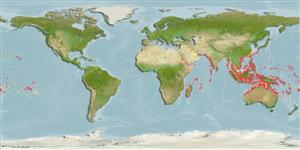
Native range
This map was computer-generated and has not yet been reviewed.
Cheilodipterus macrodon   AquaMaps   Data sources: GBIF OBIS
Carica il tuo foto e Video
Immagini | Video | Google image
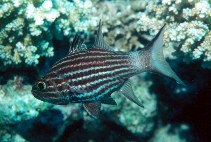
Image of Cheilodipterus macrodon (Large toothed cardinalfish)
Cheilodipterus macrodon
Immagine di Wuertz, S.

Classificazione / Nomi Nomi Comuni | Sinonimi | Catalog of Fishes(Genere, Specie) | ITIS | CoL | WoRMS | Cloffa

> Kurtiformes (Nurseryfishes, cardinalfishes.) > Apogonidae (Cardinalfishes) > Apogoninae
Etymology: Cheilodipterus: Greek, cheilos = lip + Greek, di = two + Greek, pteryx = fin (Ref. 45335).
More on author: Lacepède.

Ambiente: milieu / zona climatica / distribuzione batimetrica / gamma di distribuzione Ecologia

marino associati a barriera corallina; non migratori (Ref. 52884); distribuzione batimetrica 0 - 100 m (Ref. 9710), usually ? - 30 m (Ref. 11441). Tropical; 30°N - 35°S, 25°E - 133°W

Distribuzione Territories | Aree FAO | Ecosistemi | Presenze | Mappa dei ritrovamenti | Introduzioni | Faunafri

Indo-Pacific: Red Sea and East Africa (Ref. 8525) to Pitcairn, north to the Ryukyu Islands, south to Lord Howe Island and Rapa.

Dimensione / Peso / Età

Maturità: Lm ?  range ? - ? cm
Max length : 25.0 cm TL maschio/sesso non determinato; (Ref. 11441)

Breve descrizione Chiavi di identificazione | Morfologia | Morfometria

Spine dorsali (totale) : 7; Raggi dorsali molli (totale) : 9; Spine anali: 2; Raggi anali molli: 8. Characterized by having dorsal fin rays VI-I, 9; anal fin rays II,8; pectoral fin rays 12; pelvic fin rays I, 5; pored lateral line scales 25; predorsal scales 6; circumpeduncular scales 12; large canine-like teeth on jaws; preopercular margin serrated (Ref. 93839).; juveniles have a large black blotch on the caudal peduncle which becomes diffuse with age. Adults resemble adults of C. artus, but have wider stripes with darker interspace (Ref. 37816); characterized further by pale grey color; eight red-brown stripes on side, caudal fin base whitish; dark caudal fin margins; greatest depth of body 3.1-3.8 in SL (Ref. 90102).
Body shape (shape guide): short and / or deep; Cross section: compressed.

Biologia     Glossario (es. epibenthic)

Common in outer reef slopes in 4-30 m depth; in caves and ledges of clear lagoon and seaward reefs from 0.5 to at least 40 m, generally hovering solitarily in midwater (Ref. 1602). Adults usually in pairs or small groups comprising several pairs; juveniles solitary or small groups (Ref. 48635). Monogamous and always in home-ranging pairs, that is they do not defend an exclusive territory (Ref. 52884). Adults feed primarily on small fishes (Ref. 9710). Sexual maturity reached at about 8 cm. Maximum depth reported taken from Ref. 128797.

Ciclo vitale e comportamento di accoppiamento Maturità | Riproduzione | Deposizione | Uova | Fecondità | Larve

Mouthbrooders (Ref. 240). Distinct pairing during courtship and spawning (Ref. 205). Displays obligate monogamy where a one-to-one pair is established irrespective of resource abundance (Ref. 52884).

Riferimento principale Caricare le referenze | Bibliografia | Coordinatore | Collaboratori

Gon, O., 1993. Revision of the cardinalfish genus Cheilodipterus (Perciformes: Apogonidae), with description of five new species. Indo-Pac. Fish. (22):59 p. (Ref. 8525)

Stato della Lista Rossa IUCN (Ref. 130435: Version 2025-2 (Global))


CITES

Not Evaluated

CMS (Ref. 116361)

Not Evaluated

Minaccia per l'uomo

  Harmless


Usi umani

FAO - Publication: search | FishSource | Sea Around Us

Informazioni ulteriori

Ecologia trofica
Articoli alimentari (prede)
Alimentazione
Consumo di cibo
Razioni alimentari
Predatori
Ecologia
Ecologia
Dinamica della popolazione
Parametri di crescita
Età massima / dimensioni massime
Rapporto lunghezza-peso.
Lunghezza-lunghezza rel.
Lunghezza-frequenze
Conversione di massa
Reclutamento
Abbondanza
Ciclo di vita
Riproduzione
Maturità
Maturità/Gli occhielli sono relativi.
Fecondità
Deposizione
Aggregazioni riproduttive
Uova
Sviluppo delle uova
Larve
Dinamica popolazioni larvali
Distribuzione
Territories
Aree FAO
Ecosistemi
Presenze
Introduzioni
BRUVS - Video
Anatomia
Area branchiale
Cervello
Otolite
Fisiologia
Composizione corporea
Nutrienti
Consumo di ossigeno
Tipo di nuoto
Velocità di nuoto
Pigmenti visivi
Suono del pesce
Malattie e parassiti
Tossicità (LC50)
Genetica
Genome
Genetica
Eterozigosi
Ereditarietà
Diversità genetica
Legato all'uomo
Sistemi di acquacoltura
Profili di acquacoltura
Varietà
Casi di Ciguatera
Francobolli, monete, materiale vario.
Raggiungimento
Collaboratori
Bibliografia
Bibliografia

Strumenti

Rapporti speciali

Scarica XML

Fonti Internet

AFORO (otoliths) | Aquatic Commons | BHL | Cloffa | Websites from users | Check FishWatcher | CISTI | Catalog of Fishes: Genere, Specie | DiscoverLife | ECOTOX | FAO - Publication: search | Faunafri | Fishipedia | Fishtrace | GloBI | Google Books | Google Scholar | Google | IGFA World Record | Database Nazionali | OneZoom | Open Tree of Life | Otolith Atlas of Taiwan Fishes | PubMed | Reef Life Survey | Socotra Atlas | TreeBase | Tree of Life | Wikipedia: Go, ricerca | World Records Freshwater Fishing | Record zoologico

Stime basate su modelli

Temperatura preferita (Fonte Biblio. 123201): 24.7 - 29, mean 27.8 °C (based on 1114 cells).
Indice di diversità filogenetica (Fonte Biblio. 82804):  PD50 = 0.5000   [Uniqueness, from 0.5 = low to 2.0 = high].
Bayesian length-weight: a=0.01202 (0.00722 - 0.02002), b=3.17 (3.03 - 3.31), in cm total length, based on LWR estimates for this species & (Sub)family-body (Ref. 93245).
Livello trofico (Fonte Biblio. 69278):  4.1   ±0.61 se; based on food items.
Resilienza (Fonte Biblio. 120179):  Medio, tempo minimo di raddoppiamento della popolazione 1.4 - 4.4 anni (Preliminary K or Fecundity.).
Vulnerabilità della pesca (Ref. 59153):  Low vulnerability (15 of 100). 🛈
Nutrienti (Ref. 124155):  Calcium = 66.1 [33.7, 114.0] mg/100g; Iron = 0.638 [0.370, 1.043] mg/100g; Protein = 19 [18, 20] %; Omega3 = 0.124 [0.076, 0.197] g/100g; Selenium = 29.8 [17.0, 56.1] μg/100g; VitaminA = 59.1 [17.9, 189.2] μg/100g; Zinc = 1.02 [0.70, 1.49] mg/100g (wet weight);