Clasificación / Nombres
Nombres comunes | Sinónimos | Catalog of Fishes(Género, Especie) | ITIS | CoL | WoRMS | Cloffa
>
Characiformes (Characins) >
Lebiasinidae (Pencilfishes) > Pyrrhulininae
Etymology: Pyrrhulina: Greek, pyrrhos = red, with the colour of the fire (Ref. 45335).
More on authors: Zarske & Géry.
Entorno: milieu / zona climática / rango de profundidad / gama de distribución
Ecología
; agua dulce bentopelágico. Tropical
South America: Rio Tapajós basin, Brazil.
Tamaño / Peso / Edad
Madurez: Lm ? range ? - ? cm
Max length : 3.7 cm SL macho / no sexado; (Ref. 38400)
Descripción breve
Claves de identificación | Morfología | Morfometría
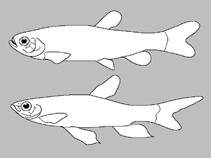
Espinas dorsales (total) : 2; Radios blandos dorsales (total) : 7 - 8; Espinas anales: 3 - 4; Radios blandos anales: 7 - 8; Vértebra: 32 - 33. A small species of Pyrrhulina to which it belongs because of its head morphology, although elongated body, posterior placement of dorsal fin, and elongated fin rays resemble Copella. Height at origin of pelvic fins 4.6-5 times in SL, and at origin of dorsal fin 4.8-5.1 times in SL; caudal peduncle relatively low and 1.6-2.1 times in SL; head length 3.9-4.4 times in SL; pre-dorsal length 1.5-1.6 times in SL. 21-23 scales in lateral line row; 12-13 scales on back in front of dorsal fin. Color in alcohol bright olive to brown, with a short black bar from the tip of the lower jaw to the eyes. Scales on sides with bright center. 'Spines' refer to unbranched rays.
Body shape (shape guide): elongated; Cross section: circular.
In creeks and small ponds.
Ciclo vital y comportamiento de apareamiento
Madurez | Reproducción | Puesta | Huevos | Fecundidad | Larva
Zarske, A. and J. Géry, 2001. Pyrrhulina elongata sp.n. - ein neuer Salmler aus dem Einzugsgebiet des Rio Tapajos in Brasilien (Teleostei: Characiformes: Lebiasinidae). Zool. Abh. Mus. Tierkde. Dresden 51(2):15-21. (Ref. 38400)
Situación en la Lista Roja de la UICN (Ref. 130435: Version 2025-2 (Global))
Amenaza para el ser humano
Harmless
Usos humanos
Pesquerías: de interés potencial
Herramientas
Informes especiales
Descargar XML
Fuentes de Internet
Estimaciones basadas en modelos
Índice de diversidad filogenética (Referencia
82804): PD
50 = 0.5000 [Uniqueness, from 0.5 = low to 2.0 = high].
Bayesian length-weight: a=0.00646 (0.00280 - 0.01488), b=3.13 (2.93 - 3.33), in cm total length, based on LWR estimates for this (Sub)family-body shape (Ref.
93245).
Nivel trófico (Referencia
69278): 3.2 ±0.4 se; based on size and trophs of closest relatives
Vulnerabilidad pesquera (Ref.
59153): Low vulnerability (10 of 100).
🛈