>
Cypriniformes (Carps) >
Danionidae (Danios) > Danioninae
Etymology: Devario: Bangla/Bengali:‘debari’, local name for these fishes; also meaning ‘brother in law’ (Ref. 2031).
More on authors: Fang & Kottelat.
Environnement : milieu / zone climatique / profondeur / gamme de distribution
Écologie
; eau douce benthopélagique. Tropical
Asia: presently known only from the Nam Tha watershed in Louang Namtha Province and Nam Beng watershed in Oudomxai Province, Mekong basin, northern Laos.
Taille / Poids / Âge
Maturité: Lm ? range ? - ? cm
Max length : 5.2 cm SL mâle / non sexé; (Ref. 37788)
Description synthétique
Clés d'identification | Morphologie | Morphométrie
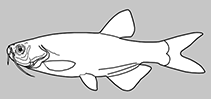
Rayons mous dorsaux (Total) : 10 - 11; Rayons mous anaux: 14 - 15; Vertèbres: 35 - 36. With complete lateral line, without infraorbital process; with mostly 7 branched dorsal-fin rays and 11 branched anal-fin rays. Danio leptos can be distinguished from other striped Danio by its slender body (body depth 25.8-27.7% SL, versus over 29.2 in most striped Danio) and a color pattern consisting in three horizontal stripes on the sides of the body, with the middle one (P stripe) deeper (about one scale deep) and more prominent that the other two (P+1 and P-1 stripes), and, anteriorly on the sides, the dark pigment organized in vertical elements, separated by thin, irregular light interspaces, which appears somewhat similar to the vertical bars in the barred Danio species. The most similar species, D. chrysotaeniatus, has 8-9 branched dorsal-fin rays and 12-13 branched anal-fin rays, and a few short, horizontal lines derived from the I-1 interspace, instead of dark blotches anteriorly on the side.
Body shape (shape guide): elongated; Cross section: compressed.
Found in a hill stream in dense forest, about 5-30 cm deep (mostly 5-10), 50-150 cm wide, with slow to moderate current, very clear water, and bottom consisting of sand to pebbles and rock outcrops. Occurs also in a forest stream 20-70 cm deep, about 4 m wide, with moderate current over pebbles and boulders and in a headwater in a secondary forest, very shallow (about 2-50 cm, but mostly 5-15), 30-200 cm wide, with very slow to slow current, clear water and bottom consisting of mud to pebbles.
Cycle de vie et comportement reproducteur
Maturité | Reproduction | Frai | Œufs | Fécondité | Larves
Fang, F. and M. Kottelat, 1999. Danio species from northern Laos, with descriptions of three new species (Teleostei: Cyprinidae). Ichthyol. Explor. Freshwat. 10(3):281-295. (Ref. 37788)
Statut dans la liste rouge de l'IUCN (Ref. 130435: Version 2025-2 (Global))
Menace pour l'homme
Harmless
Utilisations par l'homme
Pêcheries: sans intérêt
Outils
Articles particuliers
Télécharger en XML
Sources Internet
Estimations basées sur des modèles
Indice de diversité phylogénétique (Réf.
82804): PD
50 = 0.5000 [Uniqueness, from 0.5 = low to 2.0 = high].
Bayesian length-weight: a=0.00589 (0.00244 - 0.01420), b=3.12 (2.91 - 3.33), in cm total length, based on LWR estimates for this (Sub)family-body shape (Ref.
93245).
Niveau trophique (Réf.
69278): 3.0 ±0.4 se; based on size and trophs of closest relatives
Résilience (Réf.
120179): Haut, temps minimum de doublement de population inférieur à 15 mois (Preliminary K or Fecundity.).
Vulnérabilité de la pêche (Ref.
59153): Low vulnerability (10 of 100).
🛈