>
Cypriniformes (Carps) >
Gastromyzontidae (Hillstream loaches)
Etymology: elongata: Specific name from the Latin elongatus which means elongate.
Eponymy: Lieutenant-Colonel Robert Beresford Seymour Sewell CIE. [...] (Ref. 128868), visit book page.
More on author: Roberts.
Entorno: milieu / zona climática / rango de profundidad / gama de distribución
Ecología
; agua dulce demersal. Tropical
Asia: Se Kong of the Mekong basin.
Tamaño / Peso / Edad
Madurez: Lm ? range ? - ? cm
Max length : 7.3 cm SL macho / no sexado; (Ref. 38650)
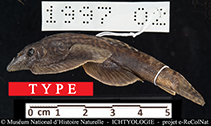
Vértebra: 35 - 37. The following combination of characters distinguished this species from its congeners: body without dark stripes; paired fins with no concentric bands; pelvic fin reaching beyond anus; general appearance elongated; body width at the origin of dorsal fin 20.7-24.4% SL; caudal peduncle depth 8.0-9.6 % SL; caudal peduncle length 1.0-1.2 times in its depth; predorsal length 46.5-49.5% SL; pelvic-fin origin in front of dorsal-fin origin; absence of cavity around mouth; skin-fold between oropectoral membrane and ventral surface of head running from pectoral-fin origin to second rostral barbel; tubercles on top of head concentrated on lateral parts of snout; absence of large tubercles on branched pectoral-fin rays 15-21; and 65-70 lateral line scales. Very dark, almost black when alive; color pattern changes after preservation (Ref. 40433).
Body shape (shape guide): elongated.
Occurs in moderately high gradient forested montane stream with large boulders, a coarse gravel or sandy bottom and some logs. Also found in an extremely high gradient, tumultuous mountain stream with huge boulders and coarse gravel bottom.
Ciclo vital y comportamiento de apareamiento
Madurez | Reproducción | Puesta | Huevos | Fecundidad | Larva
Roberts, T.R., 1998. Systematic revision of the balitorid loach genus Sewellia of Vietnam and Laos, with diagnoses of four new species. Raffles Bull. Zool. 46(2):271-288. (Ref. 38650)
Situación en la Lista Roja de la UICN (Ref. 130435: Version 2025-2 (Global))
Amenaza para el ser humano
Harmless
Usos humanos
Herramientas
Informes especiales
Descargar XML
Fuentes de Internet
Estimaciones basadas en modelos
Índice de diversidad filogenética (Referencia
82804): PD
50 = 0.5001 [Uniqueness, from 0.5 = low to 2.0 = high].
Bayesian length-weight: a=0.00646 (0.00285 - 0.01461), b=3.11 (2.91 - 3.31), in cm total length, based on LWR estimates for this (Sub)family-body shape (Ref.
93245).
Nivel trófico (Referencia
69278): 3.6 ±0.4 se; based on size and trophs of closest relatives
Vulnerabilidad pesquera (Ref.
59153): Low vulnerability (10 of 100).
🛈