Klassifizierung / Names
Namen | Synonyme | Catalog of Fishes(Gattung, Arten) | ITIS | CoL | WoRMS | Cloffa
>
Siluriformes (Catfishes) >
Siluridae (Sheatfishes)
Etymology: Belodontichthys: Greek, belos, -eos = any projectile + Greek, odous = teeth + Greek, ichthys = fish (Ref. 45335); truncatus: Specific name from the Latin truncatus (truncated), in reference to the relatively short head of this species.
More on authors: Kottelat & Ng.
Umwelt: Milieu / Klimazone / Tiefenbereich / Verbreitungsgebiet
Ökologie
; süßwasser demersal. Tropical
Asia: Chao Phraya and Mekong River drainages in Thailand, Laos, Cambodia and Viet Nam. Previously misidentified as Belodontichthys dinema from the Mekong River basin.
Größe / Gewicht / Alter
Geschlechtsreife: Lm ? range ? - ? cm
Max length : 60.0 cm SL Männchen/unbestimmt; (Ref. 43281)
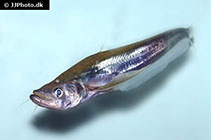
Rückenflossenweichstrahlen (insgesamt) : 3 - 4; Afterflossenweichstrahlen: 79 - 96. Differs from its sole congener, B. dinema, in having a shorter pectoral fin, 21.9-25.8% SL, versus 25.9-28.9; a shorter head, 20.9-23.9% SL, versus 24.2-26.0; and a shorter snout, 35.4-39.6% HL, versus 39.0-43.1 (Ref. 38432). Strongly compressed head and body; upturned mouth with conspicuous large teeth; pectoral fin longer than head (Ref. 43281).
Body shape (shape guide): elongated.
Occurs in medium to large-sized rivers (Ref. 12975). Found from middle depths to the surface in deeper parts of large rivers. Feeds on smaller fish near the water surface. An excellent game fish which can be caught using hook and line. Presently large numbers are being taken near Stung Treng in Cambodia by explosives (Ref. 12693). Migrates upstream through the Khone Falls in June-July with other silurids and enters the flooded forest in July-October, where it feeds heavily on cyprinids of the genus Henicorhynchus (pa soi, identified as Cirrhinus spp.) (Ref. 38432). Marketed fresh or dried and salted (Ref. 12693).
Lebenszyklus und Paarungsverhalten
Geschlechtsreife | Fortpflanzung | Ablaichen | Eier | Fruchtbarkeit | Larven
Kottelat, M. and H.H. Ng, 1999. Belodontichthys truncatus, a new species of silurid catfish from Indochina ( Teleostei: Siluridae). Ichthyol. Explor. Freshwat. 10(4):387-391. (Ref. 38432)
IUCN Rote Liste Status (Ref. 130435: Version 2025-2 (Global))
Bedrohung für Menschen
Harmless
Nutzung durch Menschen
Sportfisch: ja
Tools
Zusatzinformationen
Download XML
Internet Quellen
Schätzungen auf der Grundlage von Modellen
Phylogenetischer Diversitätsindex (Ref.
82804): PD
50 = 0.7500 [Uniqueness, from 0.5 = low to 2.0 = high].
Bayesian length-weight: a=0.00562 (0.00281 - 0.01127), b=3.00 (2.83 - 3.17), in cm total length, based on LWR estimates for this (Sub)family-body shape (Ref.
93245).
Trophische Ebene (Ref.
69278): 4.1 ±0.7 se; based on size and trophs of closest relatives
Widerstandsfähigkeit (Ref.
120179): niedrig, Verdopplung der Population dauert 4,5 - 14 Jahre. (Preliminary K or Fecundity.).
Anfälligkeit der Fischerei (Ref.
59153): Moderate to high vulnerability (49 of 100).
🛈