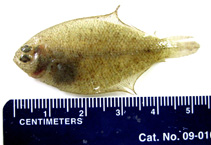
Environnement : milieu / zone climatique / profondeur / gamme de distribution
Écologie
marin démersal; profondeur ? - 31 m (Ref. 58018). Temperate
Western Central Atlantic: north of Cape Hatteras, North Carolina, to about Palm Beach on east coast of Florida and in Gulf of Mexico from Fort Myers, Florida, to Mississippi; apparently rare or absent in southern Florida.
Taille / Poids / Âge
Maturité: Lm ? range ? - ? cm
Max length : 9.0 cm SL mâle / non sexé; (Ref. 39355)
Rayons mous dorsaux (Total) : 70 - 82; Rayons mous anaux: 54 - 64.
Body shape (shape guide): other (see remarks).
Cycle de vie et comportement reproducteur
Maturité | Reproduction | Frai | Œufs | Fécondité | Larves
Distinct pairing (Ref. 205).
Leslie, A.J. Jr. and D.J. Stewart, 1986. Systematics and distributional ecology of Etropus (Pisces, Bothidae) on the Atlantic Coast of the United States with description of a new species. Copeia 1986(1):140-156. (Ref. 39355)
Statut dans la liste rouge de l'IUCN (Ref. 130435: Version 2025-2 (Global))
Menace pour l'homme
Harmless
Utilisations par l'homme
Outils
Articles particuliers
Télécharger en XML
Sources Internet
Estimations basées sur des modèles
Indice de diversité phylogénétique (Réf.
82804): PD
50 = 0.5010 [Uniqueness, from 0.5 = low to 2.0 = high].
Bayesian length-weight: a=0.00891 (0.00396 - 0.02008), b=3.02 (2.82 - 3.22), in cm total length, based on LWR estimates for this (Sub)family-body shape (Ref.
93245).
Niveau trophique (Réf.
69278): 3.4 ±0.2 se; based on size and trophs of closest relatives
Résilience (Réf.
120179): Haut, temps minimum de doublement de population inférieur à 15 mois (Preliminary K or Fecundity.).
Vulnérabilité de la pêche (Ref.
59153): Low vulnerability (10 of 100).
🛈