分類 / 名稱
俗名 | 同種異名 | Catalog of Fishes(屬, 種) | ITIS | CoL | WoRMS | Cloffa
環境: 環境 / 氣候帶 / 深度上下限 / 配送範圍
生態學
海洋; 半鹹淡水 礁區魚類; 深度上下限 5 - 80 m (Ref. 37816). 熱帶; 25°N - 21°S
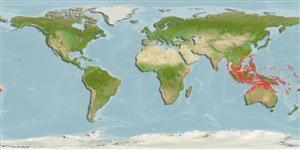
Indo-West Pacific: Thailand to Vanuatu, north to the Ryukyu Islands (Ref. 559) and southeast China, south to Australia.
印度-西太平洋: 泰國到萬那度,北至琉球群島 (參考文獻 559) 與中國東南部。
大小 / 重量 / 年齡
成熟度: Lm ? range ? - ? cm
Max length : 25.0 cm TL 雄魚/尚未辨別雌雄; (Ref. 48635)
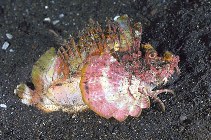
背棘 (總數) : 15 - 17; 背的軟條 (總數) : 7 - 9; 臀棘: 2; 臀鰭軟條: 10 - 12. Body colors highly variable and best identified by the patterns on the fins (Ref. 48635). Lower 2 pectoral rays are entirely free and used as "walking" legs and the inner face of the fin is brightly colored (Ref. 37816).
Body shape (shape guide): short and / or deep.
體色高變異的而且在鰭上最易鑑定出來的特徵是圖案.(參考文獻 48635) 低的 2個胸鰭鰭條完全分離而且用作了 " 步行 " 腿,而且鰭的內面是色彩鮮豔的。 (參考文獻 37816)
Found on open sandy or silty substrates of lagoon and seaward reefs. Often buries itself and easily overlooked. Uses pectoral fins to startle predators and shows color during courtship (Ref. 48635). Feeds on small fishes and crustaceans (Ref. 9710). The venom of this fish can be deadly to man. Its ability to camouflage itself by living half-buried presents a real danger. Solitary on sand and mud bottoms (Ref 90102).
棲息於潟湖與臨海礁石的開放沙的或淤泥底部了。 時常埋藏它本身並且容易被看漏而不被發現。 使用胸鰭在求偶期期間驚嚇掠食者而且展現顏色.(參考文獻 48635) 吃小魚與甲殼動物。 (參考文獻 9710) 這一個魚的毒液能是致人於死。 藉由半埋藏的生活習性偽裝它本身的它能力呈現一種真正的危險。
生命週期和交配行為
成熟度 | 繁殖 | 產卵場 | 卵 | 孕卵數 | 仔魚
印度-西太平洋: 泰國到萬那度,北至琉球群島 (參考文獻 559) 與中國東南部。
Myers, R.F., 1991. Micronesian reef fishes. Second Ed. Coral Graphics, Barrigada, Guam. 298 p. (Ref. 1602)
IUCN 瀕危狀態 (Ref. 130435: Version 2025-2 (Global))
無危 (LC) ; Date assessed: 18 August 2023
人類使用
漁業: 商業性; 水族館: 商業性
工具
特別的報告
下載 XML
網路資源
基於模型的估計
首選溫度 (參考文獻
123201): 26.3 - 29, mean 28.2 °C (based on 1088 cells).
系統發育多樣性指數 (參考文獻
82804): PD
50 = 0.5010 [Uniqueness, from 0.5 = low to 2.0 = high].
Bayesian length-weight: a=0.01862 (0.01017 - 0.03409), b=2.90 (2.73 - 3.07), in cm total length, based on LWR estimates for this species & (Sub)family-body (Ref.
93245).
營養階層 (參考文獻
69278): 4.0 ±0.66 se; based on food items.
回復力 (參考文獻
120179): 中等的, 族群倍增時間最少 1.4 - 4.4年 (Preliminary K or Fecundity.).
釣魚的脆弱性 (Ref.
59153): Low vulnerability (15 of 100).
🛈
營養素 (Ref.
124155): Calcium = 55.4 [23.3, 140.2] mg/100g; Iron = 0.564 [0.265, 1.169] mg/100g; Protein = 18 [16, 20] %; Omega3 = 0.197 [0.081, 0.589] g/100g; Selenium = 31.7 [15.2, 76.9] μg/100g; VitaminA = 81.8 [20.5, 340.5] μg/100g; Zinc = 1.22 [0.79, 1.85] mg/100g (wet weight);