>
Cichliformes (Cichlids, convict blennies) >
Cichlidae (Cichlids) > Etroplinae
Etymology: Paretroplus: Name from the Greek 'para' meaning 'on the side of'; in taxonomy it is commonly used in generic names to express similarity or relatedness; in the present case it would mean 'next to Etroplus' (S.Kullander, pers.comm. 3/11); maromandia: Named for the village and general region from which the species was first collected; the Malagasy prefix maro- translates to many in English, and the Malagasy suffix -mandia means to tread on or to go on a way (= journey) in English; the epithet, maromandia, is used as a noun in apposition (Ref. 39755).
Ambiente: milieu / zona climática / intervalo de profundidade / gama de distribuição
Ecologia
; Água doce demersal. Tropical
Africa: northwestern Madagascar (Ref. 78623).
Tamanho / Peso / Idade
Maturidade: Lm ? range ? - ? cm
Max length : 13.0 cm SL macho/indeterminado; (Ref. 78623)
Descrição breve
Chaves de identificação | Morfologia | Morfometria
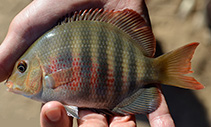
Espinhos dorsais (total) : 15 - 16; Raios dorsais moles (total) : 20 - 23; Espinhos anais: 8 - 9; Raios anais moles: 14 - 16. Diagnosis: Paretroplus maromandia is a member of the deep-bodied clade of Paretroplus and the only member of the genus, apart from P. polyactis, in which the entire lateral series of bars is prominent, including in adults; it is the only species of Paretroplus occurring in western drainages with strong lateral barring (Ref. 78623). Paretroplus maromandia is distinguished from P. polyactis by the presence of lateral bars that extend more or less over the entire flank, from the dorsal-fin base, and sometimes extending onto the fin membrane itself, to the anal-fin base, vs. bars that terminate approximately under the lateral midline and do not extend to the anal-fin base in P. polyactis; by a greater lateral-line scale count, 39-41 vs. 31-36; fewer gill rakers on the lower limb of the first arch, 10 vs. 11-13; a higher dorsal-fin ray count, 20-23 vs. 15-18; and by bright yellow to greenish-yellow body ground colouration interrupted by seven prominent, solid black vertical bars on the flanks, vs. bars and intervening regions highly speckled/spotted and resembling a chain-link fence, owing to pigmentation pattern in which scale margins are markedly darker than centers in P. polyactis (Ref. 78623). In life, P. maromandia is further distinguished from P. polyactis by a golden iris, vs. red, and the presence of vivid red pigmentation on the flanks, below the lateral midline (Ref. 78623).
Body shape (shape guide): fusiform / normal.
Ciclo de vida e comportamento de acasalamento
Maturidade | Reprodução | Desova | Ovos | Fecundidade | Larvas
Sparks, J.S., 2008. Phylogeny of the cichlid subfamily Etroplinae and taxonomic revision of the Malagasy cichlid genus Paretroplus (Teleostei: Cichlidae). Bull. Am. Mus. Nat. Hist. 314:1-151. (Ref. 78623)
Categoria na Lista Vermelha da IUCN (Ref. 130435: Version 2025-2 (Global))
Ameaça para o homem
Harmless
Utilização humana
Ferramentas
Relatórios especiais
Descarregue XML
Fontes da internet
Estimativas baseadas em modelos
Índice de diversidade filogenética (Ref.
82804): PD
50 = 0.5001 [Uniqueness, from 0.5 = low to 2.0 = high].
Bayesian length-weight: a=0.01660 (0.00670 - 0.04111), b=2.95 (2.74 - 3.16), in cm total length, based on LWR estimates for this (Sub)family-body shape (Ref.
93245).
Nível Trófico (Ref.
69278): 2.9 ±0.3 se; based on size and trophs of closest relatives
Resiliência (Ref.
120179): Elevada, tempo mínimo de duplicação da população menor que 15 meses (Preliminary K or Fecundity.).
Vulnerabilidade da pesca (Ref.
59153): Low vulnerability (10 of 100).
🛈