>
Gonorynchiformes (Milkfishes) >
Gonorynchidae (Beaked salmons)
Etymology: Gonorynchus: Greek, gonia (γονια) = angle, corner + Greek, rhyngchos (or rhúnkhos - ῥύγχος) = snout (Ref. 45335).
Eponymy: Johann Reinhold Forster (1729–1798) was a German clergyman in Danzig (now Gdansk, Poland). [...] (Ref. 128868), visit book page.
More on author: Ogilby.
Environnement : milieu / zone climatique / profondeur / gamme de distribution
Écologie
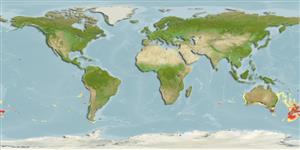
marin démersal; océanodrome (Ref. 48492); profondeur 104 - 1233 m (Ref. 48492). Subtropical; 11°S - 58°S
Southwest Pacific. New Zealand and New Caledonia. Distribution crosses three broad climate zones (subtropical, temperate, and subantarctic) and two biogeographic/hydrographic barriers (tropical and subtropical convergence zones).
Taille / Poids / Âge
Maturité: Lm ? range ? - ? cm
Max length : 48.6 cm SL mâle / non sexé; (Ref. 38037)
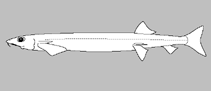
Rayons mous dorsaux (Total) : 10 - 11; Rayons mous anaux: 7 - 8; Vertèbres: 64 - 66. Pigmented brown dorsally and orange-pink ventrally; fins have dark gray patches contrasting with pale gray patches at the margins. Lower lip of mouth with elongated forked papillae. Lateral line pore tubes positioned between every 2 scales instead of the common pattern of 2:1:2 (Ref. 38037). Caudal vertebrae (= pleural caudal vertebrae + ural caudal vertebrae) 12 + 1. Lateral line scale pattern of 2:2:2 (that is, 2 scales: pore, 2 scales: pore, etc.)
Body shape (shape guide): elongated.
Inhabits coastal sandy habitats , bays and estuaries where they remain buried during the day. Also found in deeper water 160-678 m. Juvenile, subadult and adult occur in shallow coastal areas; adults also inhabit deep shelf and slope areas and isolated offshore plateaus, and are capable of moving between the two (Ref. 48492). With the first New Caledonian record based on one ripe female and one spent male, captured at 960-1233 m depth, over 700 nautical miles from the nearest known populations, it is hypothesized that adult sandfish migrates along oceanic ridges to spawn in southern New Caledonian waters (Ref. 48492).
Cycle de vie et comportement reproducteur
Maturité | Reproduction | Frai | Œufs | Fécondité | Larves
Grande, T., 1999. Revision of the genus Gonorynchus Scopoli, 1777 (Teleostei: Ostariophysi). Copeia 1999(2):453-469. (Ref. 38037)
Statut dans la liste rouge de l'IUCN (Ref. 130435: Version 2025-2 (Global))
Menace pour l'homme
Harmless
Utilisations par l'homme
Outils
Articles particuliers
Télécharger en XML
Sources Internet
Estimations basées sur des modèles
Température préférée (Réf.
123201): 7.6 - 14.3, mean 9.5 °C (based on 134 cells).
Indice de diversité phylogénétique (Réf.
82804): PD
50 = 0.5625 [Uniqueness, from 0.5 = low to 2.0 = high].
Bayesian length-weight: a=0.00389 (0.00180 - 0.00842), b=3.12 (2.94 - 3.30), in cm total length, based on all LWR estimates for this body shape (Ref.
93245).
Niveau trophique (Réf.
69278): 2.0 ±0.1 se; based on size and trophs of closest relatives
Vulnérabilité de la pêche (Ref.
59153): Moderate vulnerability (44 of 100).
🛈