>
Tetraodontiformes (Puffers and filefishes) >
Balistidae (Triggerfishes)
Etymology: Rhinecanthus: Greek, rhinos = nose + Greek, akantha = thorn (Ref. 45335).
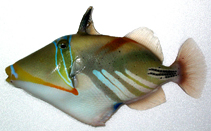
Eponymy: Pablo Ruiz Picasso (1881–1973) was a Spanish painter and sculptor. The vivid patterns and colours of Rhinecanthus triggerfish have led to them being popularly known as picassofish. (Ref. 128868), visit book page.
More on author: Linnaeus.
Milieu: milieu / Klimaatzone / Diepte / verspreidingsgebied
Ecologie
marien rifbewoner; diepte 0 - 50 m (Ref. 7348). Tropical; 30°N - 30°S
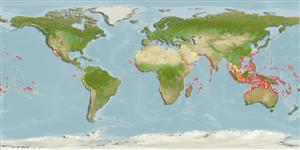
Indo-Pacific: East Africa eastward through northern Australia to Hawaiian, Marquesas and Tuamotu islands, north to southern Japan.
Lengte bij maturiteit / Grootte / Gewicht / Leeftijd
Maturiteit: Lm 14.0 range ? - ? cm
Max length : 30.0 cm TL mannelijk / geslacht onbekend; (Ref. 4420); common length : 15.0 cm TL mannelijk / geslacht onbekend; (Ref. 5450)
Dorsale stekels (totaal) : 3; Dorsale zachte stralen (totaal) : 23 - 26; Anale stekels: 0; Anale zachte stralen: 21 - 23.
Body shape (shape guide): short and / or deep.
Commonly found in subtidal reef flats and shallow protected lagoons, Ref. 48637. Benthopelagic (Ref. 58302). Juveniles secretive with rubble patches, adults swim about openly but are usually shy (Ref. 48637). Territorial. Feed on algae, detritus, mollusks, crustaceans, worms, sea urchins, fishes, corals, tunicates, forams, and eggs (Ref. 3921). Oviparous (Ref. 205). Sleep on its side; makes a whirring noise when alarmed (Ref. 4420). Also caught with drive-in nets and is considered a popular aquarium fish (Ref. 9770).
Levenscyclus en paargedrag
Maturiteit | Voortplanting | Paaien | Eieren | Fecunditeit | Larven
Distinct pairing (Ref. 205). Mating system may be a mixture of polygyny, monogamy, and potential promiscuity in solitary females but the primary mating system considered for this species is polygyny (Ref. 116439). Females are territorial, solely tending and guarding the eggs (Ref. 116451). Males exhibit polygyny (Ref. 116451).
Myers, R.F., 1991. Micronesian reef fishes. Second Ed. Coral Graphics, Barrigada, Guam. 298 p. (Ref. 1602)
Status op de Rode Lijst van het IUCN (Ref. 130435: Version 2025-2 (Global))
Gevaar voor de mens
Reports of ciguatera poisoning (Ref. 130160)
Gebruik door de mens
Visserij: van minder commercieel belang; Aquarium: Commercieel
Tools
Speciale rapporten
Download XML
Internetbronnen
Schattingen op basis van modellen
Gewenste temperatuur (Ref.
123201): 24.5 - 29, mean 27.7 °C (based on 1010 cells).
Fylogenetische diversiteitsindex (Ref.
82804): PD
50 = 0.5078 [Uniqueness, from 0.5 = low to 2.0 = high].
Bayesian length-weight: a=0.02042 (0.01172 - 0.03557), b=2.91 (2.76 - 3.06), in cm total length, based on LWR estimates for this species & (Sub)family-body (Ref.
93245).
Trofisch niveau (Ref.
69278): 3.2 ±0.1 se; based on diet studies.
Generation time: 2.7 ( na - na) years. Estimated as median ln(3)/K based on 1
growth studies.
Weerstandsvermogen (Ref.
120179): Hoog, minimale populatieverdubbelingstijd minder dan 15 maanden (K=0.4).
Kwetsbaarheid van de visserij (Ref.
59153): Low to moderate vulnerability (30 of 100).
🛈
Voedingsstoffen (Ref.
124155): Calcium = 46.5 [19.5, 110.3] mg/100g; Iron = 0.619 [0.323, 1.399] mg/100g; Protein = 18.3 [16.2, 20.5] %; Omega3 = 0.115 [0.058, 0.223] g/100g; Selenium = 34.7 [18.2, 72.2] μg/100g; VitaminA = 54.6 [15.8, 190.6] μg/100g; Zinc = 1.12 [0.76, 1.64] mg/100g (wet weight);