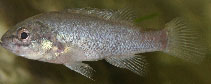
Klassifizierung / Names
Namen | Synonyme | Catalog of Fishes(Gattung, Arten) | ITIS | CoL | WoRMS | Cloffa
>
Centrarchiformes (Basses) >
Percichthyidae (Temperate perches) > Percichthyinae
Etymology: Guyu: A word of the kuku yolangi, aboriginal people in Australia. Kuyu=freshwater fish; "k" is pronounced as "g" in N. Queensland. The species "wujalwujalensis" is due to its ocurrences in the town of Wujal Wujal.(Brad & Mark Kennard, Griffith University, 1993); wujalwujalensis: Named for the township Wujal Wujal at the base of the Bloomfield Falls.
Umwelt: Milieu / Klimazone / Tiefenbereich / Verbreitungsgebiet
Ökologie
; süßwasser pelagisch; pH range: 5.0 - 6.0; tiefenbereich 0 - 4 m (Ref. 40636). Tropical; 21°C - 23°C (Ref. 40636)
Oceania: Australia.
Größe / Gewicht / Alter
Geschlechtsreife: Lm ? range ? - ? cm
Max length : 10.1 cm SL Männchen/unbestimmt; (Ref. 40636)
Rückenflossenstacheln (insgesamt) : 6 - 7; Rückenflossenweichstrahlen (insgesamt) : 8 - 9; Afterflossenstacheln: 3; Afterflossenweichstrahlen: 7 - 9; Wirbelzahl: 25 - 26. Head deep and laterally compressed; pores on head and lower jaw; snout tapered. Insertion of the pelvic fin in line with the third dorsal spine and well behind pectoral fin base. Pelvic girdle length at least twice its width. Caudal fin rounded. Cleithrum's posterior margin and opercular spines without serrations; post temporal serrated.
Body shape (shape guide): fusiform / normal; Cross section: compressed.
Inhabits a broad (30-40 meters wide), clear, flowing stream with a rocky bottom. Temperature ranges between 15° and 25°C and pH from 5.0 to 6.0. During the day it shelters in the cover of undercut banks, boulders, log snags and submerged root masses, darting into crevices if threatened. Nocturnally active, feeding on insects and their larvae, crustaceans, fishes and plant matter. Sexual maturity is reached at a length of about five centimeters. One of the most recently discovered Australian freshwater fish species (Ref. 44894).
Lebenszyklus und Paarungsverhalten
Geschlechtsreife | Fortpflanzung | Ablaichen | Eier | Fruchtbarkeit | Larven
Pusey, B.J. and M.J. Kennard, 2001. Guyu wujalwujalensis, a new genus and species (Pisces: Percichthyidae) from northeastern Queensland, Australia. Ichthyol. Explor. Freshwat. 12(1):17-28. (Ref. 40636)
IUCN Rote Liste Status (Ref. 130435: Version 2025-2 (Global))
Bedrohung für Menschen
Harmless
Nutzung durch Menschen
Tools
Zusatzinformationen
Download XML
Internet Quellen
Schätzungen auf der Grundlage von Modellen
Phylogenetischer Diversitätsindex (Ref.
82804): PD
50 = 1.0000 [Uniqueness, from 0.5 = low to 2.0 = high].
Bayesian length-weight: a=0.01047 (0.00397 - 0.02763), b=3.01 (2.78 - 3.24), in cm total length, based on LWR estimates for this (Sub)family-body shape (Ref.
93245).
Trophische Ebene (Ref.
69278): 3.3 ±0.5 se; based on size and trophs of closest relatives
Widerstandsfähigkeit (Ref.
120179): hoch, Verdopplung der Population dauert weniger als 15 Monate. (Preliminary K or Fecundity.).
Anfälligkeit der Fischerei (Ref.
59153): Low vulnerability (10 of 100).
🛈