Umwelt: Milieu / Klimazone / Tiefenbereich / Verbreitungsgebiet
Ökologie
seewasser bathydemersal; tiefenbereich 786 - 872 m (Ref. 40826). Deep-water
Verbreitung
Territorien | FAO Gebiete | Ökosysteme | Vorkommen | Punkt Karte | Einführungen | Faunafri
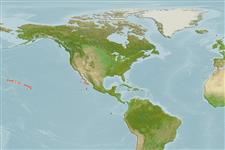
Eastern Central Pacific: Hawaiian Islands.
Größe / Gewicht / Alter
Geschlechtsreife: Lm ? range ? - ? cm
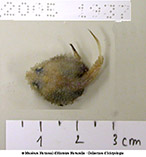
Max length : 13.6 cm SL Männchen/unbestimmt; (Ref. 40826)
Rückenflossenweichstrahlen (insgesamt) : 6 - 7; Wirbelzahl: 18. Unique tubercles multi-spined, clustered in center of each tubercle. No large rostral spine, nor long simple spines on dorsal surface of disc. Tubercles along sides of tail each with 2-4 long, irregularly sized, somewhat flaring spines. Toothed scutes on tubercles absent. (Ref. 40826).
Body shape (shape guide): short and / or deep; Cross section: flattened.
Lebenszyklus und Paarungsverhalten
Geschlechtsreife | Fortpflanzung | Ablaichen | Eier | Fruchtbarkeit | Larven
Bradbury, M.G., 1999. A review of the fish genus Dibranchus with descriptions of new species and a new genus, Solocisquama (Lophiiformes, Ogcocephalidae). Proc. Calif. Acad. Sci. 51(5):259-310. (Ref. 40826)
IUCN Rote Liste Status (Ref. 130435: Version 2025-2 (Global))
Bedrohung für Menschen
Harmless
Nutzung durch Menschen
Tools
Zusatzinformationen
Download XML
Internet Quellen
Schätzungen auf der Grundlage von Modellen
Phylogenetischer Diversitätsindex (Ref.
82804): PD
50 = 0.6250 [Uniqueness, from 0.5 = low to 2.0 = high].
Bayesian length-weight: a=0.02455 (0.01000 - 0.06026), b=2.94 (2.73 - 3.15), in cm total length, based on LWR estimates for this (Sub)family-body shape (Ref.
93245).
Trophische Ebene (Ref.
69278): 3.3 ±0.6 se; based on size and trophs of closest relatives
Widerstandsfähigkeit (Ref.
120179): mittel, Verdopplung der Population dauert 1,4 - 4,4 Jahre. (Preliminary K or Fecundity.).
Anfälligkeit der Fischerei (Ref.
59153): Low vulnerability (10 of 100).
🛈