>
Cypriniformes (Carps) >
Cobitidae (Spined loaches)
Etymology: Cobitis: Greek, kobitis, -idos = a kind of sardine; also related with the voice Greek, kobios, Latin gobius = gudgeon (Ref. 45335); puncticulata: puncticula latin noun (or adjective?) meaning small sting, dot, or freckle, an allusion to its pigmentation consiting of small dots.
More on authors: Erk'akan, Atalay-Ekmekçi & Nalbant.
Environnement : milieu / zone climatique / profondeur / gamme de distribution
Écologie
; eau douce benthopélagique. Temperate
Europe and Asia: Lower Maritza drainage in Greece. Lakes Manyas and Ulubat drainages in Turkey. Most likey have a wider distribution (Ref. 59043).
Taille / Poids / Âge
Maturité: Lm ? range ? - ? cm
Max length : 6.2 cm SL mâle / non sexé; (Ref. 41095); 7.8 cm SL (female)
Description synthétique
Clés d'identification | Morphologie | Morphométrie
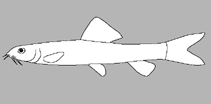
Épines dorsales (Total) : 3; Rayons mous dorsaux (Total) : 6; Épines anales: 2; Rayons mous anaux: 5. Body relatively high, head small, eyes placed in anterior part. Unusual color pattern, consists of small dark-gray dots, throughout body and head. Mouth slightly arched with three pairs of long barbels. Lips finely furrowed. Mental lobes developed, with pointed tips. Appears unique in its morphological features.
Pigmentation (Gambetta's longitudinal zone of pigmentation): blotches of zone Z2 and Z4 very small, indistinct or confluent; flank pigmented below zone Z4. One lamina circularis (Ref. 59043).
Body shape (shape guide): elongated.
Found in streams with still to moderately flowing clear water and mud bottom (Ref. 59043). Oviparous, possibly with distinct pairing during breeding similar to congeners (Ref. 205).
Cycle de vie et comportement reproducteur
Maturité | Reproduction | Frai | Œufs | Fécondité | Larves
During courtship, 'the male follows the female and, after both enter dense vegetation (e.g. filamentous algae), the male forms a complete ring around the female's body behind the dorsal as the female releases the eggs' (Ref. 59043).
Erk'akan, F., F.G. Atalay-Ekmekçi and T.T. Nalbant, 1998. Four new species and one new subspecies of the genus Cobitis (Pisces: Ostariophysi: Cobitidae) from Turkey. Turk. J. Zool. 22:9-15. (Ref. 41095)
Statut dans la liste rouge de l'IUCN (Ref. 130435: Version 2025-2 (Global))
Menacé (EN) (B2ab(i,ii,iii,v)); Date assessed: 27 August 2022
Menace pour l'homme
Harmless
Utilisations par l'homme
Outils
Articles particuliers
Télécharger en XML
Sources Internet
Estimations basées sur des modèles
Indice de diversité phylogénétique (Réf.
82804): PD
50 = 0.5000 [Uniqueness, from 0.5 = low to 2.0 = high].
Bayesian length-weight: a=0.00513 (0.00231 - 0.01140), b=3.09 (2.92 - 3.26), in cm total length, based on LWR estimates for this Genus-body shape (Ref.
93245).
Niveau trophique (Réf.
69278): 3.2 ±0.4 se; based on size and trophs of closest relatives
Résilience (Réf.
120179): Milieu, temps minimum de doublement de population : 1,4 à 4,4 années (Assumed Fec < 10,000).
Vulnérabilité de la pêche (Ref.
59153): Low vulnerability (10 of 100).
🛈