>
Anguilliformes (Eels and morays) >
Nettastomatidae (Duckbill eels)
Etymology: Saurenchelys: Greek, sauros = lizard + Greek,enchelys, -yos = eel (Ref. 45335); meteori: Named after the German research vessel 'Meteor'.
Eponymy: These fish are named after the German research vessel ‘Meteor’, from which the holotypes were collected. (Ref. 128868), visit book page.
Environnement : milieu / zone climatique / profondeur / gamme de distribution
Écologie
marin démersal; profondeur ? - 705 m (Ref. 37587). Deep-water
Western Indian Ocean: Sudan, Red Sea.
Taille / Poids / Âge
Maturité: Lm ? range ? - ? cm
Max length : 44.2 cm TL mâle / non sexé; (Ref. 37587)
Description synthétique
Clés d'identification | Morphologie | Morphométrie
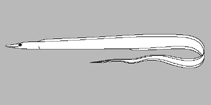
Épines dorsales (Total) : 0; Épines anales: 0; Vertèbres: 248. Posterior nostril in front of upper half of eye, with a rather large flap; narrow patch of teeth in 2-3 regular series on pterygoids; a row of enlarged caniniform teeth medially on vomer, on both sides associated with 2-5 series of smaller caniniform teeth. Body short, but longer than in other Indo-Pacific species. Tail long and tapering. Other characteristics: dorsal fin rays 418; anal fin rays 301; lateral line pores 206.
Body shape (shape guide): eel-like.
Cycle de vie et comportement reproducteur
Maturité | Reproduction | Frai | Œufs | Fécondité | Larves
Klausewitz, W. and U. Zajonz, 2000. Saurenchelys meteori n. sp. From the deep Red Sea and redescriptions of the type specimens of Saurenchelys cancrivora Peters, 1865, Chlopsis fierasfer Jordan & Snyder, 1901, and Nettastoma elongatum Kotthaus, 1968 . . . . Fauna of Arabia 18:337-355. (Ref. 37587)
Statut dans la liste rouge de l'IUCN (Ref. 130435: Version 2025-2 (Global))
Menace pour l'homme
Harmless
Utilisations par l'homme
Outils
Articles particuliers
Télécharger en XML
Sources Internet
Estimations basées sur des modèles
Indice de diversité phylogénétique (Réf.
82804): PD
50 = 0.5005 [Uniqueness, from 0.5 = low to 2.0 = high].
Bayesian length-weight: a=0.00087 (0.00035 - 0.00219), b=2.98 (2.76 - 3.20), in cm total length, based on LWR estimates for this (Sub)family-body shape (Ref.
93245).
Niveau trophique (Réf.
69278): 3.4 ±0.5 se; based on size and trophs of closest relatives
Résilience (Réf.
120179): Faible, temps minimum de doublement de population : 4,5 à 14 années (Assuming tmax>10).
Vulnérabilité de la pêche (Ref.
59153): Low to moderate vulnerability (34 of 100).
🛈