>
Eupercaria/misc (Various families in series Eupercaria) >
Nemipteridae (Threadfin breams, Whiptail breams)
Etymology: Scolopsis: Name from the Greek masculine noun 'skolos' meaning 'thorn' and suffix '-opsis' (from Greek feminine n. 'opsis' meaning 'aspect', 'appearance') meaning ‘thorny appearance’ presumably referring to 'les dentelures de la préopercule, en ont aussi, et même d'épineuses, aux sous-orbitaires' mentioned by Cuvier (1814) in his designation of the genus. Name ending in -'opsis' are treated as feminine according to ICZN 1999: Article 30.1.2 (Ref. 130620).
More on author: Cuvier.
สิ่งแวดล้อม : สิ่งแวดล้อม / เขตภูมิอากาศ / ระดับความลึก / ระยะการกระจายสินค้า
นิเวศวิทยา
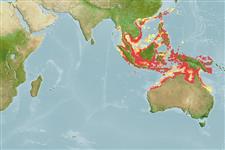
เกี่ยวกับทะเล,น้ำเค็ม สัตว์น้ำหน้าดิน; ระดับความลึก 2 - 50 m (Ref. 9785). Tropical; 26°N - 11°S, 93°E - 130°E (Ref. 120866)
Western Pacific: Southeast Asia (Taiwan Myanmar, Vietnam, Thailand, Malaysia, Indonesia and the Philippines); with two geographic populations: Philippines and the other countries in the region.
ขนาด / น้ำหนัก / อายุ
วัยเจริญพันธุ์: Lm ? range ? - ? cm
Max length : 25.0 cm SL เพศผู้/กระเทย; (Ref. 90102); common length : 15.0 cm SL เพศผู้/กระเทย; (Ref. 3810)
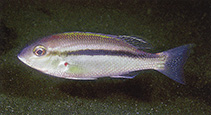
เงี่ยงครีบหลัง (รวม) : 10; ก้านครีบอ่อนที่หาง (รวม) : 9; เงี่ยงครีบก้น: 3; ก้านครีบอ่อนที่ก้น: 7. This species is distinguished by the following characters: head scales reaching forward to between level of anterior margin of eyes and posterior nostrils; no scales on the bony opercular ridge and lower limb of the preopercle; antrorse spine below the eye absent; pectoral-fin rays 16-18; lateral-line scales 46-49. Colour of upper body greyish-yellow, whitish below; sides of body with faint oblique blue and yellow lines, horizontal on the caudal peduncle; a narrow blue stripe joining eyes just behind nostrils; a blue stripe from middle of upper lip to lower edge of eye; upper part of pectoral-fin base with a reddish orange spot; fins are yellowish; dorsal fin with a blue stripe along its middle area; upper tip of caudal fin bright yellow; upper base of caudal fin with a blue spot (Ref. 9785, 118977).
Body shape (shape guide): fusiform / normal; Cross section: oval.
Occurs inshore on sand or mud bottoms (Ref. 118677). Swims in small groups. Feeds on small crustaceans, mollusks and fishes. Most abundant species of Scolopsis seen in Singapore, Malaysia and Thailand. Trawled in moderate numbers along with other species in the South China Sea and Gulf of Thailand. Highly rated as a food fish, although it sells for a low price and no major fishery exists. Sold fresh and prepared steamed or used for fish balls; sometimes salted or dried (Ref. 9785).
วงจรชีวิตและพฤติกรรมการผสมพันธุ์
วัยเจริญพันธุ์ | การสืบพันธุ์ | การวางไข่ | เซลสืบพันธ์ของเพศเมีย(ไข่) | ความดกของไข่ | ตัวอ่อน
Russell, B.C., 1990. FAO Species Catalogue. Vol. 12. Nemipterid fishes of the world. (Threadfin breams, whiptail breams, monocle breams, dwarf monocle breams, and coral breams). Family Nemipteridae. An annotated and illustrated catalogue of nemipterid species known to date. FAO Fish. Synop. 125(12):149p. Rome: FAO. (Ref. 3810)
สถานะบัญชีแดงของ IUCN (Ref. 130435: Version 2025-2 (Global))
ภัยคุกคามต่อมนุษย์
Harmless
การใช้ของมนุษย์
การประมง: การค้า
เครื่องมือ
รายงานพิเศษ
ดาวน์โหลด XML
แหล่งที่มาจากอินเตอร์เน็ต
การประมาณค่าตามแบบจำลอง
อุณหภูมิที่ต้องการ (อ้างอิง
123201): 25.7 - 29, mean 28.3 °C (based on 914 cells).
ดัชนีความหลากหลายทางวิวัฒนาการ (อ้างอิง
82804): PD
50 = 0.5000 [Uniqueness, from 0.5 = low to 2.0 = high].
Bayesian length-weight: a=0.01259 (0.00810 - 0.01956), b=3.00 (2.88 - 3.12), in cm total length, based on LWR estimates for this species & Genus-body shape (Ref.
93245).
ระดับชั้นอาหาร (อ้างอิง
69278): 3.9 ±0.61 se; based on food items.
Generation time: 2.3 ( na - na) years. Estimated as median ln(3)/K based on 1
growth studies.
ความสามารถในการกลับคืนสู่ปกติ (อ้างอิง
120179): ความสูง, เวลาต่ำสุดที่จะทำให้ประชากรเพิ่มขึ้นเป็น 2 เท่าใช้เวลาน้อยกว่า 15 เดือน (K=0.4-1).
ความเสี่ยงต่อการตกปลา (Ref.
59153): Low to moderate vulnerability (27 of 100).
🛈
สารอาหาร (Ref.
124155): Calcium = 241 [94, 522] mg/100g; Iron = 1.58 [0.76, 2.88] mg/100g; Protein = 18.5 [16.6, 20.2] %; Omega3 = 0.269 [0.149, 0.485] g/100g; Selenium = 55.4 [27.8, 113.1] μg/100g; VitaminA = 14.7 [4.0, 44.2] μg/100g; Zinc = 1.26 [0.85, 1.89] mg/100g (wet weight);