>
Eupercaria/misc (Various families in series Eupercaria) >
Nemipteridae (Threadfin breams, Whiptail breams)
Etymology: Scolopsis: Name from the Greek masculine noun 'skolos' meaning 'thorn' and suffix '-opsis' (from Greek feminine n. 'opsis' meaning 'aspect', 'appearance') meaning ‘thorny appearance’ presumably referring to 'les dentelures de la préopercule, en ont aussi, et même d'épineuses, aux sous-orbitaires' mentioned by Cuvier (1814) in his designation of the genus. Name ending in -'opsis' are treated as feminine according to ICZN 1999: Article 30.1.2 (Ref. 130620).
More on authors: Quoy & Gaimard.
Milieu: milieu / Klimaatzone / Diepte / verspreidingsgebied
Ecologie
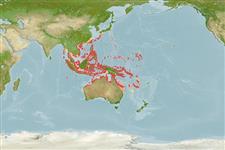
marien rifbewoner; diepte 1 - 20 m (Ref. 9785). Tropical; 33°N - 27°S, 93°E - 172°E (Ref. 3810)
Eastern Indian Ocean and Western Pacific: throughout the southeastern Indian Ocean, including Cocos-Keeling Islands and northwestern Australia, and from the Ryukyu Islands to the Marshall Islands and Vanuatu. Record from the Andaman Islands is unconfirmed. Referred to as Scolopsis cancellatus by most authors.
Grootte / Gewicht / Leeftijd
Maturiteit: Lm ? range ? - ? cm
Max length : 25.0 cm TL mannelijk / geslacht onbekend; (Ref. 90102); common length : 13.0 cm SL mannelijk / geslacht onbekend; (Ref. 3810)
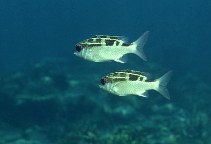
Dorsale stekels (totaal) : 10; Dorsale zachte stralen (totaal) : 9; Anale stekels: 3; Anale zachte stralen: 7. Head scales reaching forward to or just in front of level of anterior margin of eye. Lower limb of preopercle naked. Antrorse (forward-directed) suborbital spine absent. Pelvic fins long, reaching beyond level of anus. Color: Upper body olive brown, silvery-white below. 3 yellowish white stripes along head and body. Juveniles white, with 3 black bands on upper half of body, interspace between lower pair of yellow bands; black spot between first three dorsal spines.
Body shape (shape guide): fusiform / normal; Cross section: oval.
Common on coral reefs usually associated with sandy areas. Adults inhabit outer lagoon reef flats and seaward reefs flats, often in groups. Juveniles are found singly near the shelter of corals on clear shallow lagoon reefs (Ref. 9710). Adults form schools or small groups (Ref. 48635). Feeds on small fishes, crustaceans (Ref. 9710) and benthic invertebrates, primarily polychaetes (Ref. 37816).
Levenscyclus en paargedrag
Maturiteit | Voortplanting | Paaien | Eieren | Fecunditeit | Larven
Russell, B.C., 1990. FAO Species Catalogue. Vol. 12. Nemipterid fishes of the world. (Threadfin breams, whiptail breams, monocle breams, dwarf monocle breams, and coral breams). Family Nemipteridae. An annotated and illustrated catalogue of nemipterid species known to date. FAO Fish. Synop. 125(12):149p. Rome: FAO. (Ref. 3810)
Status op de Rode Lijst van het IUCN (Ref. 130435: Version 2025-2 (Global))
Gevaar voor de mens
Harmless
Gebruik door de mens
Visserij: van minder commercieel belang; Aquarium: Commercieel
Tools
Speciale rapporten
Download XML
Internetbronnen
Schattingen op basis van modellen
Gewenste temperatuur (Ref.
123201): 26 - 29.3, mean 28.7 °C (based on 1995 cells).
Fylogenetische diversiteitsindex (Ref.
82804): PD
50 = 0.5000 [Uniqueness, from 0.5 = low to 2.0 = high].
Bayesian length-weight: a=0.01445 (0.00892 - 0.02343), b=2.98 (2.85 - 3.11), in cm total length, based on LWR estimates for this species & Genus-body shape (Ref.
93245).
Trofisch niveau (Ref.
69278): 3.8 ±0.59 se; based on food items.
Generation time: 0.8 ( na - na) years. Estimated as median ln(3)/K based on 1
growth studies.
Weerstandsvermogen (Ref.
120179): Hoog, minimale populatieverdubbelingstijd minder dan 15 maanden (K>1).
Kwetsbaarheid van de visserij (Ref.
59153): Low vulnerability (15 of 100).
🛈
Voedingsstoffen (Ref.
124155): Calcium = 86.1 [49.8, 193.9] mg/100g; Iron = 0.9 [0.4, 2.2] mg/100g; Protein = 19.3 [17.4, 21.1] %; Omega3 = 0.148 [0.082, 0.264] g/100g; Selenium = 33.3 [17.3, 65.4] μg/100g; VitaminA = 44.9 [12.3, 147.8] μg/100g; Zinc = 1.41 [0.93, 2.14] mg/100g (wet weight);