>
Pleuronectiformes (Flatfishes) >
Poecilopsettidae (Bigeye flounders)
Etymology: Poecilopsetta: Greek, poikilos = with a lot of colours + Greek, psetta = grouper (Ref. 45335); normani: Named for J.P. Norman.
Eponymy: John Roxborough Norman (1898–1944) was an English ichthyologist who started his working life as a bank clerk. [...] (Ref. 128868), visit book page.
Ambiente: milieu / zona climatica / distribuzione batimetrica / gamma di distribuzione
Ecologia
marino demersale; distribuzione batimetrica 130 - 300 m (Ref. 41434). Tropical
Western Indian Ocean: Saya de Malha Bank.
Dimensione / Peso / Età
Maturità: Lm ? range ? - ? cm
Max length : 13.7 cm TL maschio/sesso non determinato; (Ref. 41434)
Breve descrizione
Chiavi di identificazione | Morfologia | Morfometria
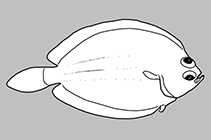
Raggi dorsali molli (totale) : 64 - 68; Raggi anali molli: 54 - 58; Vertebre: 40 - 42. Body ellipsoid with depth slightly less than half the length. Asymmetrical mouth, small, transverse. Scales small, deeply seated in the skin; circular on the blind side, pectinate on the eyed side. Pectoral fin rays : eyed side 13-15, blind side 11-13 (Ref. 41434).
Body shape (shape guide): short and / or deep; Cross section: flattened.
Ciclo vitale e comportamento di accoppiamento
Maturità | Riproduzione | Deposizione | Uova | Fecondità | Larve
Foroshchuk, V.P. and V.V. Fedorov, 1992. Poecilopsetta normani -- a new species of flounder (Pleuronectidae) from the Saya de Malha Bank, Indian Ocean. J. Ichthyol. 32(7):37-44. (Ref. 41434)
Stato della Lista Rossa IUCN (Ref. 130435: Version 2025-2 (Global))
Minaccia per l'uomo
Harmless
Usi umani
Pesca: bycatch
Strumenti
Rapporti speciali
Scarica XML
Fonti Internet
Stime basate su modelli
Indice di diversità filogenetica (Fonte Biblio.
82804): PD
50 = 0.5000 [Uniqueness, from 0.5 = low to 2.0 = high].
Bayesian length-weight: a=0.01995 (0.00906 - 0.04395), b=3.01 (2.83 - 3.19), in cm total length, based on all LWR estimates for this body shape (Ref.
93245).
Livello trofico (Fonte Biblio.
69278): 3.5 ±0.4 se; based on size and trophs of closest relatives
Vulnerabilità della pesca (Ref.
59153): Low vulnerability (10 of 100).
🛈