>
Gadiformes (Cods) >
Macrouridae (Grenadiers or rattails)
Etymology: Coelorinchus: Greek, koilos = a hollow + Greek, rhyngchos = jaw (Ref. 45335); sereti: Named for Bernard Séret, ORSTOM.
Eponymy: Dr Bernard Séret (d: 1949) is an ichthyologist and marine biologist who is a senior scientist at IRD (Institut de Recherche pour le Développement) and is currently hosted by the Department of Systematics and Evolution, Muséum National d’Histoire [...] (Ref. 128868), visit book page.
More on authors: Iwamoto & Merrett.
Environnement : milieu / zone climatique / profondeur / gamme de distribution
Écologie
marin bathydémersal; profondeur 412 - 825 m (Ref. 35908). Deep-water
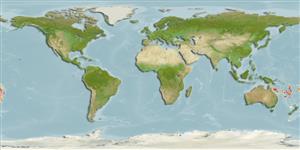
Western Central Pacific: New Caledonia and Chesterfield and Bellona Plateau.
Taille / Poids / Âge
Maturité: Lm ? range ? - ? cm
Max length : 45.0 cm TL mâle / non sexé; (Ref. 35908)
Description synthétique
Clés d'identification | Morphologie | Morphométrie
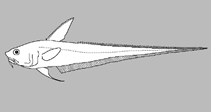
Épines dorsales (Total) : 2. Snout long, narrow, sharply pointed; orbit about 1.4, internasal about 2.0 into snout length; anterolateral margin completely supported by bone. Orbit diameter 1.2 of interorbital width. Mouth small, upper jaw slightly less than orbit diameter. Subopercle terminates in long slender tip. Dermal window of light organ small but prominent, external length about equal to length of posterior nostril. Anus slightly removed from anal fin. Underside of head covered with small prickly scales except along margins; nasal fossa and top of snout scaled. Body scales with 6 to 8 widely divergent spinule rows, middle row largest. First dorsal dark dusky, other fins dusky; body lacking distinctive markings in adults, but with faint to prominent saddles in young; mouth black, gums dark.
Body shape (shape guide): elongated.
A benthic species found on the continental slope (Ref. 75154).
Cycle de vie et comportement reproducteur
Maturité | Reproduction | Frai | Œufs | Fécondité | Larves
Iwamoto, T. and N.R. Merrett, 1997. Pisces Gadiformes: Taxonomy of grenadiers of the New Caledonian region, southwest Pacific. Mem. Mus. Natl. Hist. Nat. (176):473-570. (Ref. 35908)
Statut dans la liste rouge de l'IUCN (Ref. 130435: Version 2025-2 (Global))
Menace pour l'homme
Harmless
Utilisations par l'homme
Outils
Articles particuliers
Télécharger en XML
Sources Internet
Estimations basées sur des modèles
Température préférée (Réf.
123201): 6.2 - 10.1, mean 7.7 °C (based on 123 cells).
Indice de diversité phylogénétique (Réf.
82804): PD
50 = 0.5000 [Uniqueness, from 0.5 = low to 2.0 = high].
Bayesian length-weight: a=0.00257 (0.00132 - 0.00501), b=3.19 (3.02 - 3.36), in cm total length, based on LWR estimates for this Genus-body shape (Ref.
93245).
Niveau trophique (Réf.
69278): 3.6 ±0.5 se; based on size and trophs of closest relatives
Résilience (Réf.
120179): Faible, temps minimum de doublement de population : 4,5 à 14 années (Preliminary K or Fecundity.).
Vulnérabilité de la pêche (Ref.
59153): Low to moderate vulnerability (35 of 100).
🛈