การจำแนกประเภท / ชื่อ
ชื่อสามัญ | ชื่อพ้อง | Catalog of Fishes(สกุล, ชนิด) | ITIS | CoL | WoRMS | Cloffa
>
Pleuronectiformes (Flatfishes) >
Soleidae (Soles)
Etymology: Aseraggodes: Greek, aggos, -eos, -ous = vessel, uterus, carapace of a crab + Greek, aseros, -a, -on = to remove the appetite (Ref. 45335).
More on author: Chabanaud.
สิ่งแวดล้อม : สิ่งแวดล้อม / เขตภูมิอากาศ / ระดับความลึก / ระยะการกระจายสินค้า
นิเวศวิทยา
เกี่ยวกับทะเล,น้ำเค็ม สัตว์น้ำหน้าดิน; ระดับความลึก 35 - 68 m (Ref. 57561). Tropical
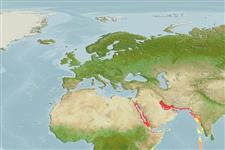
Western Indian Ocean: Red Sea.
ขนาด / น้ำหนัก / อายุ
วัยเจริญพันธุ์: Lm ? range ? - ? cm
Max length : 7.9 cm SL เพศผู้/กระเทย; (Ref. 57561)
คำอธิบายสั้นๆ
เครื่องมือที่ใช้ในการแยกชนิดสัตว์,สิ่งมีชีวิตออกจากกัน | สัณฐานวิทยา | ความยาวต่างๆ
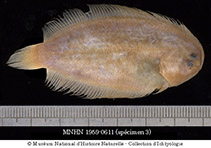
ก้านครีบอ่อนที่หาง (รวม) : 59 - 67; ก้านครีบอ่อนที่ก้น: 40 - 45; สัตว์มีกระดูกสันหลัง: 35. Diagnosis: Dorsal rays 62 (59-67); anal rays 43 (40-45); dorsal and anal rays unbranched; caudal rays 18, the upper 3 and lower 2 unbranched, the remaining rays mostly double branched; pelvic rays 5, unbranched; lateral-line scales 62 (62-72), including 8 (7-10) anterior to upper end of gill opening; lateral line projecting anteriorly toward dorsal edge of upper eye; vertebrae 35 (5 specimens) to 36 (5 specimens); dorsal pterygiophores anterior to fourth neural spine 10-11 (one of nine with 10); body depth 2.3-2.7 in SL; head length (HL) 3.45-4.15 in SL. Remaining measurements just for lectotype: snout 3.05 in HL; preorbital length 3.5 in HL; eye diameter 6.95 in HL; interorbital space 16.5 in HL; tubular anterior nostril short, not reaching cutaneous anterior edge of eye when laid back; maxilla extending posterior to a vertical through middle of lower eye, the upper-jaw length 3.8 in HL; upper end of gill opening on a horizontal passing through ventral edge of lower eye; cirri on front of snout and ventral side of head slender and small; slender cirri along edge of operculum at gill opening on blind side; no cirri detected on dorsal or anal rays; no caudal peduncle depth of caudal-fin base 1.7 in HL; longest dorsal and anal rays 1.6 in HL; caudal fin short, 4.3 in SL; pelvic-fins just reaching base of second anal ray, the ocular-side pelvic fin longer; longest pelvic ray 2.7 in HL; color of ocular side of lectotype tan, the fins pale yellowish; color in formalin as reported: very pale, uniformly and densely dotted with brown, with some larger dots of the same shade of brown, especially on fins (Ref. 57561).
Body shape (shape guide): short and / or deep.
วงจรชีวิตและพฤติกรรมการผสมพันธุ์
วัยเจริญพันธุ์ | การสืบพันธุ์ | การวางไข่ | เซลสืบพันธ์ของเพศเมีย(ไข่) | ความดกของไข่ | ตัวอ่อน
Goren, M. and M. Dor, 1994. An updated checklist of the fishes of the Red Sea (CLOFRES II). The Israel Academy of Sciences and Humanities, Jerusalem, Israel. 120 p. (Ref. 12541)
สถานะบัญชีแดงของ IUCN (Ref. 130435: Version 2025-2 (Global))
ภัยคุกคามต่อมนุษย์
Harmless
การใช้ของมนุษย์
เครื่องมือ
รายงานพิเศษ
ดาวน์โหลด XML
แหล่งที่มาจากอินเตอร์เน็ต
การประมาณค่าตามแบบจำลอง
อุณหภูมิที่ต้องการ (อ้างอิง
123201): 22.3 - 28.2, mean 23.6 °C (based on 20 cells).
ดัชนีความหลากหลายทางวิวัฒนาการ (อ้างอิง
82804): PD
50 = 0.5000 [Uniqueness, from 0.5 = low to 2.0 = high].
Bayesian length-weight: a=0.00955 (0.00454 - 0.02011), b=3.07 (2.90 - 3.24), in cm total length, based on LWR estimates for this (Sub)family-body shape (Ref.
93245).
ระดับชั้นอาหาร (อ้างอิง
69278): 3.5 ±0.5 se; based on size and trophs of closest relatives
ความสามารถในการกลับคืนสู่ปกติ (อ้างอิง
120179): ความสูง, เวลาต่ำสุดที่จะทำให้ประชากรเพิ่มขึ้นเป็น 2 เท่าใช้เวลาน้อยกว่า 15 เดือน (Preliminary K or Fecundity.).
ความเสี่ยงต่อการตกปลา (Ref.
59153): Low vulnerability (10 of 100).
🛈