Elasmobranchii (haaien en roggen) (sharks and rays) >
Carcharhiniformes (Ground sharks) >
Hemigaleidae (Weasel sharks)
Etymology: Hemigaleus: hemi-, from hemisys (Gr.), half, referring to similarity to and/or close affinity with Galeus (now in Pentanchidae) (See ETYFish); microstoma: micro-, from mikros (Gr.), small; stoma (Gr.), mouth, referring to very short arched mouth compared with Chaenogaleus macrostoma, its presumed congener at the time (See ETYFish).
More on author: Bleeker.
Taxonomic Remarks
Specimens from Australia (and probably Papua New Guinea) are placed in Hemigaleus australiensis White, Last & Compagno, 2005 (Ref. 56150).
Milieu: milieu / Klimaatzone / Diepte / verspreidingsgebied
Ecologie
marien demersaal. Tropical; 22°C - 28°C (Ref. 244); 28°N - 30°S
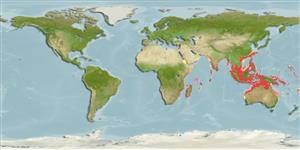
Indo-West Pacific: southern India and Sri Lanka; China to Indonesia (Ref. 56150). Also from Red Sea (Ref. 93009).
Specimens found in Australia (and probably Papua New Guinea) belong to a separate species, Hemigaleus australiensis (Ref. 56150).
Lengte bij maturiteit / Grootte / Gewicht / Leeftijd
Maturiteit: Lm ?, range 78 - ? cm
Max length : 135 cm TL mannelijk / geslacht onbekend; (Ref. 130455); max. gepubliceerd gewicht: 14.0 kg (Ref. 130455)
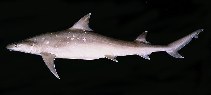
Dorsale stekels (totaal) : 0; Anale stekels: 0. Australian specimens with dark-tipped fins; tooth counts 28-34/43-54; total vertebral counts 111 to 118 (Ref. 13567). Indonesian, Singapore and Thailand specimens with light-tipped fins; tooth counts 25-32/37-43; total vertebral counts 137 to 150 (Ref. 13567). Grey-brown above, lighter below, dorsal fins with white tips and posterior margins, sometimes with spots on sides of body (Ref. 13567).
Body shape (shape guide): elongated.
A small, relatively common inshore and offshore shark of tropical continental seas (Ref. 13567). Feeds mainly on cephalopods, particularly octopi (Ref. 13567) but also takes crustaceans and cephalopods (Ref. 244). Viviparous (Ref. 50449). Taken regularly in inshore artisanal fisheries (Ref.244), commonly caught by inshore gillnet, bottom trawl and, to a lesser extent, longline fisheries. Utilized for human consumption (Ref. 244). Offal used for fishmeal (Ref. 244).
Viviparous, with a yolk-sac placenta; 4 to 14 fetuses in a litter (Ref. 13567); 2-4 pups after a gestation period of about 6 months; born at about 45-47 cm TL (Ref. 58048). Size of full-term fetuses (detached umbilical cords and placentae) ranges from 23.7 to 25.6 cm (Ref. 244). Distinct pairing with embrace (Ref. 205).
Compagno, L.J.V., 1984. FAO Species Catalogue. Vol. 4. Sharks of the world. An annotated and illustrated catalogue of shark species known to date. Part 2 - Carcharhiniformes. FAO Fish. Synop. 125(4/2):251-655. Rome: FAO. (Ref. 244)
Status op de Rode Lijst van het IUCN (Ref. 130435: Version 2025-2 (Global))
Gebruik door de mens
Visserij: van minder commercieel belang
Tools
Speciale rapporten
Download XML
Internetbronnen
Schattingen op basis van modellen
Gewenste temperatuur (Ref.
123201): 22.2 - 28.3, mean 27 °C (based on 816 cells).
Fylogenetische diversiteitsindex (Ref.
82804): PD
50 = 0.7539 [Uniqueness, from 0.5 = low to 2.0 = high].
Bayesian length-weight: a=0.00214 (0.00107 - 0.00426), b=3.10 (2.92 - 3.28), in cm total length, based on LWR estimates for this species & (Sub)family-body (Ref.
93245).
Trofisch niveau (Ref.
69278): 4.2 ±0.4 se; based on diet studies.
Weerstandsvermogen (Ref.
120179): Zeer laag, minimale populatieverdubbelingstijd meer dan 14 jaar (Fec=4).
Kwetsbaarheid van de visserij (Ref.
59153): Very high vulnerability (81 of 100).
🛈
Voedingsstoffen (Ref.
124155): Calcium = 27.9 [4.5, 154.3] mg/100g; Iron = 0.693 [0.182, 2.119] mg/100g; Protein = 19 [17, 21] %; Omega3 = 0.114 [0.048, 0.271] g/100g; Selenium = 54.1 [16.0, 167.0] μg/100g; VitaminA = 22.3 [7.2, 70.4] μg/100g; Zinc = 0.769 [0.374, 1.395] mg/100g (wet weight);