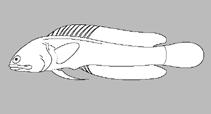
>
Ovalentaria/misc (Various families in series Ovalentaria) >
Opistognathidae (Jawfishes)
Etymology: Opistognathus: Greek, opisthe = behind + Greek, gnathos = jaw (Ref. 45335); to the very elongate upper jaw of the type species of the genus, Opistognathus nigromarginatus (Ref. 128653).
More on author: Peters.
Umwelt: Milieu / Klimazone / Tiefenbereich / Verbreitungsgebiet
Ökologie
seewasser riff-verbunden. Tropical
Western Central Pacific.
Größe / Gewicht / Alter
Geschlechtsreife: Lm ? range ? - ? cm
Found on the continental shelf; over silt bottom (Ref. 75154).
Lebenszyklus und Paarungsverhalten
Geschlechtsreife | Fortpflanzung | Ablaichen | Eier | Fruchtbarkeit | Larven
Smith-Vaniz, W.F., 1999. Opistognathidae. Jawfishes. p. 2588-2589. In K.E. Carpenter and V.H. Niem (eds.) FAO species identification guide for fishery purposes. The living marine resources of the Western Central Pacific. Volume 4. Bony fishes part 2 (Mugilidae to Carangidae). FAO, Rome. (Ref. 40511)
IUCN Rote Liste Status (Ref. 130435: Version 2025-2 (Global))
Bedrohung für Menschen
Harmless
Nutzung durch Menschen
Tools
Zusatzinformationen
Download XML
Internet Quellen
Schätzungen auf der Grundlage von Modellen
Phylogenetischer Diversitätsindex (Ref.
82804): PD
50 = 0.5000 [Uniqueness, from 0.5 = low to 2.0 = high].
Bayesian length-weight: a=0.00389 (0.00180 - 0.00842), b=3.12 (2.94 - 3.30), in cm total length, based on all LWR estimates for this body shape (Ref.
93245).
Trophische Ebene (Ref.
69278): 3.5 ±0.6 se; based on size and trophs of closest relatives
Anfälligkeit der Fischerei (Ref.
59153): Low vulnerability (10 of 100).
🛈