Elasmobranchii (haaien en roggen) (sharks and rays) >
Orectolobiformes (Carpet sharks) >
Hemiscylliidae (Bamboo sharks)
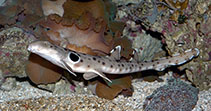
Etymology: Hemiscyllium: hemi-, from hemisys (Gr.), half, presumably referring to similarity and/ or close affinity to Scyllium (=Scyliorhinus, now in Scyliorhinidae) and/or Chiloscyllium; skylion, Greek for dogfish or small shark (See ETYFish); ocellatum: Latin for eyed, referring to conspicuous white-ringed black ocellus on flanks above pectoral fins (See ETYFish).
More on author: Bonnaterre.
Milieu: milieu / Klimaatzone / Diepte / verspreidingsgebied
Ecologie
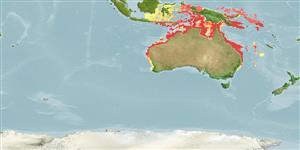
marien rifbewoner; diepte 0 - 50 m (Ref. 54540). Tropical; 1°S - 34°S, 112°E - 163°E (Ref. 54540)
Western Pacific: New Guinea and northern Australia. Possibly occurring in Malaysia, Sumatra (Indonesia), and the Solomon Islands.
Lengte bij maturiteit / Grootte / Gewicht / Leeftijd
Maturiteit: Lm ?, range 60 - ? cm
Max length : 107 cm TL mannelijk / geslacht onbekend; (Ref. 247)
Dorsale stekels (totaal) : 0; Anale stekels: 0. Caudal fin with a pronounced subterminal notch but without a ventral lobe (Ref. 13575). Lateral ocellus not surrounded by large spots; spots present on head in front and below eyes (Ref. 13575).
Body shape (shape guide): elongated.
Commonly found in shallow water of coral reefs (Ref. 6871). Often in tide pools (Ref. 13575). Feeds mainly on benthic invertebrates (Ref. 6871). Oviparous (Ref. 50449). Squirms when captured but cannot readily escape (Ref. 247). Survives well in aquariums (Ref. 6871). Has the ability to survive low oxygen conditions by switching of non-essential brain functions; apparently an adaption for hunting in tide-pools with low oxygen (Ref. 52022).
Levenscyclus en paargedrag
Maturiteit | Voortplanting | Paaien | Eieren | Fecunditeit | Larven
Oviparous, paired eggs are laid. Embryos feed solely on yolk (Ref. 50449). Prior to copulation, the male gets a good grasp of the female by by biting the body and even the gills (Ref. 49562, 51043).
Compagno, L.J.V., 1984. FAO Species Catalogue. Vol. 4. Sharks of the world. An annotated and illustrated catalogue of shark species known to date. Part 1 - Hexanchiformes to Lamniformes. FAO Fish. Synop. 125(4/1):1-249. Rome, FAO. (Ref. 247)
Status op de Rode Lijst van het IUCN (Ref. 130435: Version 2025-2 (Global))
Gebruik door de mens
Visserij: van geen belang
Tools
Speciale rapporten
Download XML
Internetbronnen
Schattingen op basis van modellen
Gewenste temperatuur (Ref.
123201): 24.1 - 28, mean 26.9 °C (based on 262 cells).
Fylogenetische diversiteitsindex (Ref.
82804): PD
50 = 0.5020 [Uniqueness, from 0.5 = low to 2.0 = high].
Bayesian length-weight: a=0.00407 (0.00182 - 0.00914), b=3.09 (2.89 - 3.29), in cm total length, based on LWR estimates for this (Sub)family-body shape (Ref.
93245).
Trofisch niveau (Ref.
69278): 3.4 ±0.2 se; based on diet studies.
Weerstandsvermogen (Ref.
120179): laag, minimale populatieverdubbelingstijd 4,5-14 jaar (Fec assumed to be <100).
Kwetsbaarheid van de visserij (Ref.
59153): High vulnerability (64 of 100).
🛈
Voedingsstoffen (Ref.
124155): Calcium = 13.8 [2.7, 51.9] mg/100g; Iron = 0.395 [0.094, 1.067] mg/100g; Protein = 19.3 [17.1, 21.3] %; Omega3 = 0.0792 [, ] g/100g; Selenium = 30.9 [9.5, 86.3] μg/100g; VitaminA = 44.7 [15.7, 118.8] μg/100g; Zinc = 0.923 [0.453, 1.889] mg/100g (wet weight);