分类 / 名称
俗名 | 同种异名 | Catalog of Fishes(属, 种) | ITIS | CoL | WoRMS | Cloffa
Elasmobranchii
板鳃亚纲 (鲨鱼与 鱼) (sharks and rays) >
Lamniformes (Mackerel sharks) >
Megachasmidae (Megamouth sharks)
Etymology: Megachasma: megas (Gr.), large; chasma (Gr.), yawning hole or open mouth, referring to its unusually large oral cavity (See ETYFish); pelagios: Greek for “of the sea,” referring to its oceanic, epipelagic habitat (See ETYFish).
环境:氛围 / 气候带 / 深度上下限 / 分布范围
生态学
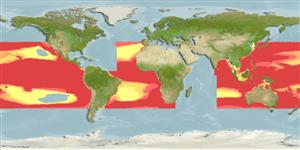
海洋 pelagic-oceanic; 海洋洄游的 (Ref. 51243); 深度上下限 5 - 600 m (Ref. 58302), usually 120 - 166 m (Ref. 48844). 深水域; 40°N - 40°S, 180°W - 180°E
Pacific Ocean: Japan, Indonesia, Philippines, Hawaii and California, USA. Atlantic Ocean: Brazil and Senegal.
太平洋: 日本,印尼,菲律賓,夏威夷與美國加州。 大西洋: 巴西與塞內加爾。
首次成熟时的长度 / 大小 / 重量 / 年龄
成熟度: Lm ?, range 540 - ? cm
Max length : 549 cm TL 雄鱼/尚未辨别雌雄; (Ref. 85838); 709.0 cm TL (female)
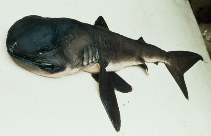
背棘 (总数) : 0; 脊椎骨: 125. Body stout, tapering posteriorly (Ref. 6871), tadpole-like with larger head and tapering trunk and tail (Ref. 47786). Snout extremely short but broadly rounded (Ref 43278, 47786). Head huge, blubbery (Ref. 6871). Mouth very broad and terminal on head, with corner extending behind the eyes (Ref. 6871, 43278). Jaws huge, protrusible anteriorly but not greatly distensible laterally (Ref. 43278, 47786), lower jaw extending to snout tip (Ref. 6871). Teeth very small, numerous, hooked (Ref. 43278, 6871, 47787). Gill slits moderately long, not reaching dorsal surface of head (Ref. 6871; 43278), internal gill slits lined with dense rows of papillose gill rakers (Ref. 43278). Eyes semicircular (Ref. 47786), with no nictitating membrane (Ref. 43278, 6871, 47786). Two dorsal fins, relatively low and angular; small anal fin; long, narrow pectoral fins; moderate-sized pelvic fin; caudal fin asymmetrical, non-lunate, with a short and strong ventral lobe; upper pre-caudal pit only; caudal peduncle without keels or ridges (Ref, 6871, 43278).
Body shape (shape guide): elongated.
身体矮胖的,后部尖端细的 (参考文献 6871) ,和像蝌蚪一样的有较大的头部与尖端细的躯干与尾部.(参考文献 47786) 吻非常短但是宽广地圆的 (参考文献 43278,47786). 头部极大的, 肥厚的.(参考文献 6871) 嘴非常宽与末端的在头部上, 藉由延伸到眼后面的角落.(参考文献 6871,43278) 颚极大的, 能向前伸展的但是不是非常扩大侧面地 (参考文献 43278,47786), 下颌延伸至吻顶端.(参考文献 6871) 齿非常小的,很多的, 钩住.(参考文献 43278,6871,47787) 鳃缝中等长度的, 不达到头部背面 (参考文献 6871; 43278), 线的内在的鳃缝,有稠密的列乳突状的鳃耙。 (参考文献 43278) 眼半圆的 (参考文献 47786), 没有瞬膜.(参考文献 43278,6871,47786) 二个背鳍, 相当低而有角的; 小的臀鳍; 长又狭窄的胸鳍; 中等大小的腹鳍; 尾鳍不对称的, 非新月状的, 具有一个短与强的腹叶; 只有的上面前尾窝; 尾梗没有龙骨脊或脊。 (参考文献,6871,43278)
Oceanic, possibly occurring in depths between 150 and 1,000 m (Ref. 6871). Epi- and mesopelagic (Ref. 58302). Feeds on planktivorous prey such as euphausiid shrimps, copepods and jellyfish (Ref. 6871). May also eat small midwater fishes. Ovoviviparous (Ref. 50449). Possibly less active than the basking and whale sharks (Ref. 6871). Its feeding habits and habitat suggest that it may be a rare catch in the future. Ovoviviparous, embryos feeding on yolk sac and other ova produced by the mother (Ref. 50449). Males mature by 400 cm (Ref. 6871). A bright white band on the snout just above the upper jaw may play a role in feeding behavior or with recognition of individuals (Ref. 47761). Preyed on by the semi-parasitic cookiecutter shark, Isistius brasiliensis.
大洋性的, 可能地深度介于 150 与 1,000 公尺之间出现在.(参考文献 6871) 吃食浮游生物的猎物例如磷虾,桡脚类的动物与水母。 (参考文献 6871) 可能也吃小的中层水域鱼。 卵胎生的.(参考文献 50449) 可能比较不活跃超过象鲛与鲸鲨.(参考文献 6871) 它的食性与栖息地显示出它未来可能是一个稀有的。 卵胎生的, 胚胎吃产生于母亲的卵黄囊与其他的卵.(参考文献 50449) 雄性成熟 400 公分。 (参考文献 6871) 在上颌的正上方的在吻部上的一条亮白色的条紋可能扮演攝取食物的行為的一個角色或具有個體的辨認.(參考文獻 47761) 被半-寄生的雪茄鯊, 雪茄鮫〔Isistius brasiliensis〕 捕食了。
生命周期和交配行为
成熟度 | 繁殖 | 产卵场 | 卵 | 孕卵数 | 仔鱼
Exhibit ovoviparity (aplacental viviparity), with embryos feeding on other ova produced by the mother (oophagy) after the yolk sac is absorbed (Ref. 50449). Distinct pairing with embrace (Ref. 205). Size at birth <177 cm (Ref. 85838).太平洋: 日本,印尼,菲律賓,夏威夷與美國加州。 大西洋: 巴西與塞內加爾。
Compagno, L.J.V., 1984. FAO Species Catalogue. Vol. 4. Sharks of the world. An annotated and illustrated catalogue of shark species known to date. Part 1 - Hexanchiformes to Lamniformes. FAO Fish. Synop. 125(4/1):1-249. Rome, FAO. (Ref. 247)
世界自然保护联盟红皮书 (Ref. 130435: Version 2025-2 (Global))
人类利用
渔业: 没有兴趣
工具
特别资料
下载 XML
网络资源
基于模型的估算
首选温度 (参考文献
123201): 9.7 - 23, mean 17.8 °C (based on 247 cells).
系统发育多样性指数 (参考文献
82804): PD
50 = 1.5000 [Uniqueness, from 0.5 = low to 2.0 = high].
Bayesian length-weight: a=0.00389 (0.00180 - 0.00842), b=3.12 (2.94 - 3.30), in cm total length, based on all LWR estimates for this body shape (Ref.
93245).
营养阶层 (参考文献
69278): 3.4 ±0.2 se; based on diet studies.
回复力 (参考文献
120179): 非常低的, 最小族群倍增时间超过14 年 (Fec assumed to be <10).
渔业脆弱性 (Ref.
59153): Very high vulnerability (90 of 100).
🛈