Elasmobranquios (tiburones y rayas) (sharks and rays) >
Orectolobiformes (Carpet sharks) >
Parascylliidae (Collared carpet sharks)
Etymology: Cirrhoscyllium: cirrus, Latin for curl or tendril, referring to barbels on throat; skylion, Greek for dogfish or small shark (See ETYFish); expolitum: Latin for varnished, referring to how the shark’s body, when dry, “glistens as though varnished, owing to the peculiar character of the dermal denticles” (See ETYFish).
More on authors: Smith & Radcliffe.
Entorno: milieu / zona climática / rango de profundidad / gama de distribución
Ecología
marino demersal; rango de profundidad 180 - 190 m (Ref. 43278). Deep-water; 23°N - 10°N, 105°E - 125°E
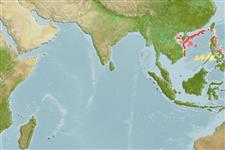
Western Pacific: South China Sea off China to the Philippines (Luzon). Gulf of Tonkin, Vietnam and Japan (off the Tanegashima Islands).
Tamaño / Peso / Edad
Madurez: Lm ? range ? - ? cm
Max length : 34.0 cm TL macho / no sexado; (Ref. 247)
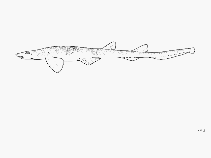
Espinas dorsales (total) : 0; Espinas anales: 0. Genus: pair of barbels on throat; color pattern of dark saddles, no light or dark spots (Ref. 43278).
Species: Six or possibly ten diffuse saddle marks on dorsal surface, saddles above abdomen rounded and continuing above pelvic-fin bases, not C-shaped, head length three times first dorsal-fin base (Ref. 43278). Gill region without collar marking (Ref. 13572).
Body shape (shape guide): elongated.
Found on the continental shelf, offshore on or near the bottom (Ref. 247). Food habits unknown (Ref. 13572). Oviparous (Ref. 43278, 50449). Interest to fisheries unknown (Ref. 13572). Probably taken as discarded by-catch of offshore trawl fisheries in the area (Ref. 43278).
Ciclo vital y comportamiento de apareamiento
Madurez | Reproducción | Puesta | Huevos | Fecundidad | Larva
Oviparous, paired eggs are laid. Embryos feed solely on yolk (Ref. 50449).
Compagno, L.J.V., 1984. FAO Species Catalogue. Vol. 4. Sharks of the world. An annotated and illustrated catalogue of shark species known to date. Part 1 - Hexanchiformes to Lamniformes. FAO Fish. Synop. 125(4/1):1-249. Rome, FAO. (Ref. 247)
Situación en la Lista Roja de la UICN (Ref. 130435: Version 2025-2 (Global))
Amenaza para el ser humano
Harmless
Usos humanos
Pesquerías: bycatch
Herramientas
Informes especiales
Descargar XML
Fuentes de Internet
Estimaciones basadas en modelos
Temperatura preferida (Referencia
123201): 8.5 - 21.9, mean 13.1 °C (based on 71 cells).
Índice de diversidad filogenética (Referencia
82804): PD
50 = 0.6289 [Uniqueness, from 0.5 = low to 2.0 = high].
Bayesian length-weight: a=0.00389 (0.00180 - 0.00842), b=3.12 (2.94 - 3.30), in cm total length, based on all LWR estimates for this body shape (Ref.
93245).
Nivel trófico (Referencia
69278): 3.6 ±0.5 se; based on size and trophs of closest relatives
Resiliencia (Referencia
120179): Bajo, población duplicada en un tiempo mínimo de 4.5-14 años (Fec assumed to be <100).
Vulnerabilidad pesquera (Ref.
59153): Low vulnerability (24 of 100).
🛈