>
Acropomatiformes (Oceanic basses) >
Acropomatidae (Lanternbellies, temperate ocean-basses)
Etymology: Acropoma: Greek, akro = topmost, summit + Greek, poma, -atos = cover (Ref. 45335); lecorneti: Cette espèce est dédiée au patron pêcheur M. Lecornet qui l'a prise à bord du 'Thalassa' (propriétaire M. Haller).
Eponymy: D Lecornet was the fisherman on board the Thalassa, who caught the holotype off New Caledonia. Nothing further was recorded. (Ref. 128868), visit book page.
Environnement : milieu / zone climatique / profondeur / gamme de distribution
Écologie
marin bathypélagique; profondeur 275 - 360 m (Ref. 117016). Deep-water
Distribution
Territoires | Zones FAO | Écosystèmes | Occurrences | Carte par point | Introductions | Faunafri
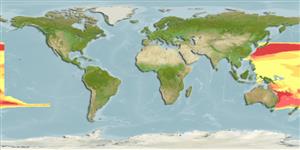
Western Pacific: East China Sea, Japan (Okinawa), NE Taiwan, off New Caledonia and Vanuatu.
Taille / Poids / Âge
Maturité: Lm ? range ? - ? cm
Max length : 32.6 cm SL mâle / non sexé; (Ref. 117016)
Description synthétique
Clés d'identification | Morphologie | Morphométrie
Épines dorsales (Total) : 9; Rayons mous dorsaux (Total) : 10; Épines anales: 3; Rayons mous anaux: 7. This species is distinguished from its congeners by the following set of characters: O-shaped luminous gland around the anus; luminous-gland length 13.2-14.6; proximal radial of the first anal-fin pterygiophore is slender lacking trough or hollow; anus pale, situated closer to the pelvic-fin origin than to that of anal fin; gill rakers 14-27; scales ctenoid except for the axil of pectoral fin and cheek (cycloid) (Ref. 117016)
Cross section: compressed.
Cycle de vie et comportement reproducteur
Maturité | Reproduction | Frai | Œufs | Fécondité | Larves
Okamoto, M. and H. Motomura, 2017. An additional specimen of a rare lanternbelly Acropoma lecorneti Perciformes: Acropomatidae) from Vanuatu, South Pacific Ocean. Cybium 41(4):373-375. (Ref. 117016)
Statut dans la liste rouge de l'IUCN (Ref. 130435: Version 2025-2 (Global))
Menace pour l'homme
Harmless
Utilisations par l'homme
Outils
Articles particuliers
Télécharger en XML
Sources Internet
Estimations basées sur des modèles
Température préférée (Réf.
123201): 13.5 - 19, mean 16.4 °C (based on 7 cells).
Indice de diversité phylogénétique (Réf.
82804): PD
50 = 0.5004 [Uniqueness, from 0.5 = low to 2.0 = high].
Bayesian length-weight: a=0.01148 (0.00474 - 0.02781), b=3.01 (2.81 - 3.21), in cm total length, based on LWR estimates for this (Sub)family-body shape (Ref.
93245).
Niveau trophique (Réf.
69278): 3.7 ±0.5 se; based on size and trophs of closest relatives
Résilience (Réf.
120179): Milieu, temps minimum de doublement de population : 1,4 à 4,4 années (Preliminary K or Fecundity.).
Vulnérabilité de la pêche (Ref.
59153): Low to moderate vulnerability (30 of 100).
🛈