Elasmobranchii (Haie und Rochen) (sharks and rays) >
Orectolobiformes (Carpet sharks) >
Parascylliidae (Collared carpet sharks)
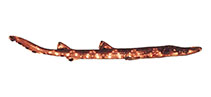
Etymology: Parascyllium: para (Gr.), near, i.e., presumed to be related to Scyliorhinus (now in Scyliorhinidae): skylion, Greek for dogfish or small shark (See ETYFish); variolatum: Latin for spotted, referring to white spots that sprinkle body (See ETYFish).
More on author: Duméril.
Umwelt: Milieu / Klimazone / Tiefenbereich / Verbreitungsgebiet
Ökologie
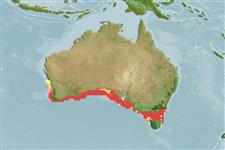
seewasser demersal; tiefenbereich ? - 180 m (Ref. 6871). Temperate; 37°S - 42°S, 113°E - 150°E (Ref. 54701)
Eastern Indian Ocean: endemic to Australia.
Größe / Gewicht / Alter
Geschlechtsreife: Lm ? range ? - ? cm
Max length : 91.0 cm TL Männchen/unbestimmt; (Ref. 247)
Found on the continental shelf at depths of inshore down to about 180 meters. Apparently occurs in a variety of habitats, including sandy bottom, on rocky reefs, in beds of kelp, and in seagrass beds, details of it ecology is, however, virtually unknown (Ref. 43278). Oviparous (Ref. 6871).
Lebenszyklus und Paarungsverhalten
Geschlechtsreife | Fortpflanzung | Ablaichen | Eier | Fruchtbarkeit | Larven
Oviparous, paired eggs are laid. Embryos feed solely on yolk (Ref. 50449).
Compagno, L.J.V., 1984. FAO Species Catalogue. Vol. 4. Sharks of the world. An annotated and illustrated catalogue of shark species known to date. Part 1 - Hexanchiformes to Lamniformes. FAO Fish. Synop. 125(4/1):1-249. Rome, FAO. (Ref. 247)
IUCN Rote Liste Status (Ref. 130435: Version 2025-2 (Global))
Bedrohung für Menschen
Harmless
Nutzung durch Menschen
Fischereien: nicht kommerziell
Tools
Zusatzinformationen
Download XML
Internet Quellen
Schätzungen auf der Grundlage von Modellen
Bevorzugte Temperatur (Ref.
123201): 14.6 - 18.3, mean 16.8 °C (based on 174 cells).
Phylogenetischer Diversitätsindex (Ref.
82804): PD
50 = 0.5352 [Uniqueness, from 0.5 = low to 2.0 = high].
Bayesian length-weight: a=0.00389 (0.00180 - 0.00842), b=3.12 (2.94 - 3.30), in cm total length, based on all LWR estimates for this body shape (Ref.
93245).
Trophische Ebene (Ref.
69278): 3.8 ±0.6 se; based on size and trophs of closest relatives
Widerstandsfähigkeit (Ref.
120179): niedrig, Verdopplung der Population dauert 4,5 - 14 Jahre. (Fec assumed to be <100).
Anfälligkeit der Fischerei (Ref.
59153): High vulnerability (56 of 100).
🛈
Nährstoffe (Ref.
124155): Calcium = 12.1 [2.4, 53.3] mg/100g; Iron = 0.254 [0.069, 0.719] mg/100g; Protein = 18.9 [16.8, 20.8] %; Omega3 = 0.41 [0.18, 0.89] g/100g; Selenium = 12.8 [3.9, 33.7] μg/100g; VitaminA = 9.56 [2.96, 29.00] μg/100g; Zinc = 0.422 [0.206, 0.758] mg/100g (wet weight);