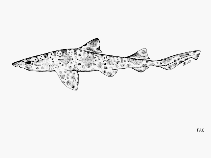
Elasmobranquios (tiburones y rayas) (sharks and rays) >
Carcharhiniformes (Ground sharks) >
Proscylliidae (Finback catsharks)
Etymology: Ctenacis: From ktenos (Gr.), comb; akis (Gr.), point, referring to its comb-like posterior teeth (See ETYFish); fehlmanni: In honor of ichthyologist-herpetologist Herman Adair Fehlmann (1917-2005), Smithsonian Oceanographic Sorting Center, for “setting high standards for field treatment of shark specimens collected for study” (See ETYFish).
Eponymy: Dr Herman Adair Fehlmann (1917–2005) of George Vanderbilt Foundation, Bangkok, and the Smithsonian was primarily an ichthyologist but also an herpetologist. [...] (Ref. 128868), visit book page.
Entorno: milieu / zona climática / rango de profundidad / gama de distribución
Ecología
marino demersal; rango de profundidad 70 - 170 m (Ref. 10004). Tropical; 11°N - 9°N
Western Indian Ocean: off Somalia.
Tamaño / Peso / Edad
Madurez: Lm ? range ? - ? cm
Max length : 52.0 cm TL (female)
Inhabits the outer continental shelf (Ref. 30573). Known only from the holotype. The presence of a very thin-walled, large egg-case in each uterus of the holotype suggests that the species may be ovoviviparous, and presumably have had two young in a litter (Ref. 244). Experts classify this species as oviparous (Ref. 50449). Its large mouth, small teeth, and large pharynx with gillraker papillae might allow it to feed on very small invertebrates, according to S. Springer.
Ciclo vital y comportamiento de apareamiento
Madurez | Reproducción | Puesta | Huevos | Fecundidad | Larva
Oviparous, paired eggs are laid. Embryos feed solely on yolk (Ref. 50449).
Compagno, L.J.V., 1984. FAO Species Catalogue. Vol. 4. Sharks of the world. An annotated and illustrated catalogue of shark species known to date. Part 2 - Carcharhiniformes. FAO Fish. Synop. 125(4/2):251-655. Rome: FAO. (Ref. 244)
Situación en la Lista Roja de la UICN (Ref. 130435: Version 2025-2 (Global))
Amenaza para el ser humano
Harmless
Usos humanos
Pesquerías: sin interés
Herramientas
Informes especiales
Descargar XML
Fuentes de Internet
Estimaciones basadas en modelos
Índice de diversidad filogenética (Referencia
82804): PD
50 = 1.0078 [Uniqueness, from 0.5 = low to 2.0 = high].
Bayesian length-weight: a=0.00288 (0.00112 - 0.00741), b=3.14 (2.91 - 3.37), in cm total length, based on LWR estimates for this (Sub)family-body shape (Ref.
93245).
Nivel trófico (Referencia
69278): 3.5 ±0.37 se; based on food items.
Resiliencia (Referencia
120179): Muy bajo, población duplicada en un tiempo mínimo superior a 14 años (Fec=2).
Vulnerabilidad pesquera (Ref.
59153): Moderate vulnerability (41 of 100).
🛈