Elasmobranquios (tiburones y rayas) (sharks and rays) >
Carcharhiniformes (Ground sharks) >
Proscylliidae (Finback catsharks)
Etymology: Eridacnis: Etymology not explained, possibly eri-, Greek intensive particle (i.e., very), and dakno (Gr.), bite, referring to “wide, angular” mouth of E. radcliffei (See ETYFish); sinuans: Latin for sinuous, probably referring to its slender body and/or long, ribbon-like caudal fin (See ETYFish).
More on author: Smith.
Entorno: milieu / zona climática / rango de profundidad / gama de distribución
Ecología
marino batidemersal; rango de profundidad 180 - 480 m (Ref. 244). Deep-water; 4°S - 30°S
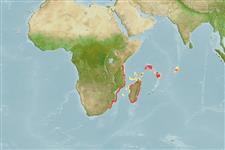
Western Indian Ocean: confined to South Africa, Mozambique and Tanzania.
Longitud en la primera madurez / Tamaño / Peso / Edad
Madurez: Lm ?, range 37 - ? cm
Max length : 37.0 cm TL (female)
Descripción breve
Claves de identificación | Morfología | Morfometría
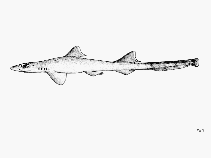
Espinas dorsales (total) : 0; Espinas anales: 0. A slender, dwarf catshark with 2 equal-sized dorsal fins and a long tape-like caudal fin (Ref. 5578). Grey-brown in color (Ref. 5578).
Body shape (shape guide): elongated.
Found on the upper continental slope and outer shelf (Ref. 244). Feeds on small bony fishes, crustaceans and cephalopods (Ref. 244). Ovoviviparous (Ref. 50449), with 2 young in a litter (Ref. 244). Geographic or bathymetric segregation of populations by sex probably occurs as most specimens taken off Natal were male (Ref. 244).
Ovoviviparous, embryos feed solely on yolk (Ref. 50449). Bears two young (Ref. 5578). Size at birth between 15 and 17 cm (Ref. 244).
Compagno, L.J.V., 1984. FAO Species Catalogue. Vol. 4. Sharks of the world. An annotated and illustrated catalogue of shark species known to date. Part 2 - Carcharhiniformes. FAO Fish. Synop. 125(4/2):251-655. Rome: FAO. (Ref. 244)
Situación en la Lista Roja de la UICN (Ref. 130435: Version 2025-2 (Global))
Amenaza para el ser humano
Usos humanos
Pesquerías: sin interés
Herramientas
Informes especiales
Descargar XML
Fuentes de Internet
Estimaciones basadas en modelos
Temperatura preferida (Referencia
123201): 12.8 - 18.4, mean 15.3 °C (based on 18 cells).
Índice de diversidad filogenética (Referencia
82804): PD
50 = 0.6328 [Uniqueness, from 0.5 = low to 2.0 = high].
Bayesian length-weight: a=0.00288 (0.00112 - 0.00741), b=3.14 (2.91 - 3.37), in cm total length, based on LWR estimates for this (Sub)family-body shape (Ref.
93245).
Nivel trófico (Referencia
69278): 4.2 ±0.58 se; based on food items.
Resiliencia (Referencia
120179): Muy bajo, población duplicada en un tiempo mínimo superior a 14 años (Fec=2).
Vulnerabilidad pesquera (Ref.
59153): Low to moderate vulnerability (27 of 100).
🛈