>
Gobiiformes (Gobies) >
Gobiidae (Gobies) > Gobionellinae
Etymology: Wuhanlinigobius: Named for Chinese ichthyologist, Prof. Wu, Han-lin, for recognizing his great contribution for the ichthyological research in China especially for gobioid fishes.
Eponymy: Dr Wu Han-Lin is a Professor of Ichthyology at Shanghai Ocean University and Director of the Fisheries Laboratory (2012), having previously been at Shanghai Fisheries University (2000). [...] (Ref. 128868), visit book page.
Environnement : milieu / zone climatique / profondeur / gamme de distribution
Écologie
marin; saumâtre démersal. Subtropical
Western Pacific: China, Taiwan, Vietnam, Singapore, northern Australia; possibly also from West Malaysia and Sulawesi..
Taille / Poids / Âge
Maturité: Lm ? range ? - ? cm
Max length : 3.2 cm SL mâle / non sexé; (Ref. 80545)
Description synthétique
Clés d'identification | Morphologie | Morphométrie
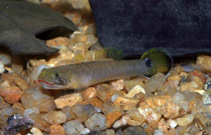
Épines dorsales (Total) : 7; Rayons mous dorsaux (Total) : 8; Épines anales: 1; Rayons mous anaux: 8 - 9; Vertèbres: 26. Distinguished by the following characteristics: small, slender-bodied; first dorsal fin VI, low, rounded and spines never filamentous ; second dorsal rays I/8; anal rays I/8-9; pectoral rays 16-19 (modally 18); longitudinal scales 47-50 (modally 48); TR 15-16 (modally 16); PreD 0-19 (modally 0); small ctenoid scales on body; (modally 48); predorsal area covered with cycloid scales in female, usually naked in male; naked on cheek, operculum, prepelvic region and pectoral base region; three horizontal blackish brown stripes on cheek and preoperculum; both sexes in adults with thin red lines at their upper and lower lip; adult male with caudal fin membrane yellow and distinct black margin; both sexes with caudal fin membrane having 3-5 vertical black lines (Ref. 94983).
Body shape (shape guide): elongated; Cross section: oval.
Usually found in mangroves, at sites not far from the sea; collected by beam trawl in shallow water or by hand during low tide on mud-banks, in tiny puddles, on exposed mud surface or partly buried in mud. One specimen in the Gulf of Carpentaria was found alive among the bases of dead mangrove Bruguiera exaristata on quite dry, firm mud (Ref. 80545).
Cycle de vie et comportement reproducteur
Maturité | Reproduction | Frai | Œufs | Fécondité | Larves
Randall, J.E. and K.K.P. Lim (eds.), 2000. A checklist of the fishes of the South China Sea. Raffles Bull. Zool. Suppl. (8):569-667. (Ref. 36648)
Statut dans la liste rouge de l'IUCN (Ref. 130435: Version 2025-2 (Global))
Menace pour l'homme
Harmless
Utilisations par l'homme
Outils
Articles particuliers
Télécharger en XML
Sources Internet
Estimations basées sur des modèles
Indice de diversité phylogénétique (Réf.
82804): PD
50 = 0.7500 [Uniqueness, from 0.5 = low to 2.0 = high].
Bayesian length-weight: a=0.00708 (0.00332 - 0.01511), b=3.07 (2.89 - 3.25), in cm total length, based on LWR estimates for this (Sub)family-body shape (Ref.
93245).
Niveau trophique (Réf.
69278): 3.2 ±0.5 se; based on size and trophs of closest relatives
Résilience (Réf.
120179): Haut, temps minimum de doublement de population inférieur à 15 mois (Preliminary K or Fecundity.).
Vulnérabilité de la pêche (Ref.
59153): Low vulnerability (10 of 100).
🛈