Élasmobranches (requins et raies) (sharks and rays) >
Carcharhiniformes (Ground sharks) >
Triakidae (Houndsharks) > Triakinae
Etymology: Mustelus: Latin for weasel, an ancient name for sharks, possibly referring to the pointed snouts, swift movements and/or rapacious feeding behavior of smaller predatory sharks [strictly not tautonymous with Squalus mustelus Linnaeus 1758 since type was designated by the ICZN] (See ETYFish); palumbes: Latin for wood-pigeon or ring-dove, referring to its dove-gray coloration (See ETYFish).
More on author: Smith.
Environnement : milieu / zone climatique / profondeur / gamme de distribution
Écologie
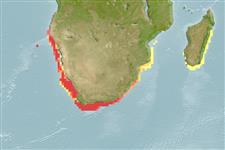
marin démersal; profondeur 0 - 443 m (Ref. 5578). Subtropical; 17°S - 36°S
Southeast Atlantic: Namibia to central Natal, South Africa.
Taille / Poids / Âge
Maturité: Lm ? range ? - ? cm
Max length : 120 cm TL mâle / non sexé; (Ref. 244)
Description synthétique
Clés d'identification | Morphologie | Morphométrie
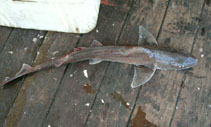
Épines dorsales (Total) : 0; Épines anales: 0. A smoothhound with lines or scatterings of small white spots along body (Ref. 5578). Grey above, white below (Ref. 5578).
Body shape (shape guide): elongated.
Found on the continental shelf and upper slope from the intertidal region to deeper waters over sand and gravel bottoms (Ref. 244). Feeds on crustaceans, octopi, bony fish, and fish offal (Ref. 5578). Ovoviviparous (Ref. 50449). Catch usually discarded but may be utilized in a local fishery that processes sharks into jerky (Ref. 244).
Cycle de vie et comportement reproducteur
Maturité | Reproduction | Frai | Œufs | Fécondité | Larves
Ovoviviparous, embryos feed solely on yolk (Ref. 50449). 3 to 8 young per litter. Born at around 25 cm. (Ref. 5485). Distinct pairing with embrace (Ref. 205).
Compagno, L.J.V., 1984. FAO Species Catalogue. Vol. 4. Sharks of the world. An annotated and illustrated catalogue of shark species known to date. Part 2 - Carcharhiniformes. FAO Fish. Synop. 125(4/2):251-655. Rome: FAO. (Ref. 244)
Statut dans la liste rouge de l'IUCN (Ref. 130435: Version 2025-2 (Global))
Menace pour l'homme
Harmless
Utilisations par l'homme
Pêcheries: intérêt commercial mineur; pêche sportive: oui
Outils
Articles particuliers
Télécharger en XML
Sources Internet
Estimations basées sur des modèles
Température préférée (Réf.
123201): 10.2 - 18, mean 12.8 °C (based on 80 cells).
Indice de diversité phylogénétique (Réf.
82804): PD
50 = 0.5000 [Uniqueness, from 0.5 = low to 2.0 = high].
Bayesian length-weight: a=0.00229 (0.00107 - 0.00491), b=3.14 (2.97 - 3.31), in cm total length, based on LWR estimates for this Genus-body shape (Ref.
93245).
Niveau trophique (Réf.
69278): 3.5 ±0.5 se; based on diet studies.
Résilience (Réf.
120179): Très faible, temps minimum de doublement de population supérieur à 14 ans (Fec=4).
Vulnérabilité de la pêche (Ref.
59153): High to very high vulnerability (72 of 100).
🛈
Nutriments (Ref.
124155): Calcium = 16.9 [4.9, 85.4] mg/100g; Iron = 0.471 [0.151, 1.782] mg/100g; Protein = 21.6 [19.3, 23.8] %; Omega3 = 0.144 [0.059, 0.331] g/100g; Selenium = 47.4 [14.1, 169.2] μg/100g; VitaminA = 6.61 [2.26, 18.61] μg/100g; Zinc = 0.615 [0.270, 1.252] mg/100g (wet weight);