>
Gobiiformes (Gobies) >
Gobiidae (Gobies) > Gobionellinae
Eponymy: Gabriel de Bustamenté was a Brazilian slave trader on São Tomé Island, Gulf of Guinea. His occupation did not stop Greef describing him as the ‘hospitable and intelligent’ (translation) owner of a farm situated on São Tomé. (Ref. 128868), visit book page.
Taxonomic Remarks
Not the same as Sicydium bustamantei Greef, 1884 (Ref. 59830), which is synonym of Lentipes bustamantaei Boulenger 1916. See taxonomic and nomenclatural details in Eschmeyer (CofF ver. Oct. 2012: Ref. 92135), issues that remain to be fixed.
Environnement : milieu / zone climatique / profondeur / gamme de distribution
Écologie
; eau douce démersal; amphidrome (Ref. 92840). Tropical
Africa: Gulf of Guinea islands of Bioko, Pagalu (=Annobon), São Tomé and Principe; specimens from the lower Ndian River (Cameroon), tentatively identified as A. bustamantei, are more likely A. lateristriga (Ref. 79590).
Taille / Poids / Âge
Maturité: Lm ? range ? - ? cm
Max length : 19.3 cm SL mâle / non sexé; (Ref. 79590)
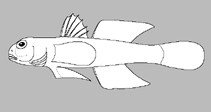
Rayons mous dorsaux (Total) : 10; Épines anales: 1; Rayons mous anaux: 10. Diagnosis: usually 18-20 scales in rearward transverse series (range 18-22); 23-30 scales around caudal peduncle; densely pigmented on dorsum and with large, dark spots on flanks (Ref. 79590).
Body shape (shape guide): elongated.
Amphidromous freshwater species (Ref. 92840). The maximum size is 193 mm SL and 242 mm TL observed, but perhaps it can reach 264 mm TL (Ref. 79590).
Cycle de vie et comportement reproducteur
Maturité | Reproduction | Frai | Œufs | Fécondité | Larves
Harrison, I.J., P.J. Miller and F. Pezold, 2008. Gobiidae. p. 492-544. In M.L.J. Stiassny, G.G. Teugels and C.D. Hopkins (eds.) The fresh and brackish water fishes of Lower Guinea, West-Central Africa. Volume 2 / Poissons d’eaux douces et saumâtres de basse Guinée, ouest de l’Afrique centrale. Volume 2. Collection Faune et Flore Tropicales 42. Muséum National d’Histoire Naturelle, Paris (France), Musée Royal de l’Afrique Central, Tervuren (Belgium), Institut de Recherche pour le Développement, Paris (France). 603 pp. (Ref. 79590)
Statut dans la liste rouge de l'IUCN (Ref. 130435: Version 2025-2 (Global))
Menace pour l'homme
Harmless
Utilisations par l'homme
Outils
Articles particuliers
Télécharger en XML
Sources Internet
Estimations basées sur des modèles
Indice de diversité phylogénétique (Réf.
82804): PD
50 = 0.5000 [Uniqueness, from 0.5 = low to 2.0 = high].
Bayesian length-weight: a=0.00871 (0.00369 - 0.02053), b=3.07 (2.90 - 3.24), in cm total length, based on LWR estimates for this Genus-body shape (Ref.
93245).
Niveau trophique (Réf.
69278): 2.2 ±0.1 se; based on size and trophs of closest relatives
Résilience (Réf.
120179): Milieu, temps minimum de doublement de population : 1,4 à 4,4 années (Preliminary K or Fecundity.).
Vulnérabilité de la pêche (Ref.
59153): Low vulnerability (14 of 100).
🛈