Elasmobranchi (squali e razze) (sharks and rays) >
Carcharhiniformes (Ground sharks) >
Triakidae (Houndsharks) > Triakinae
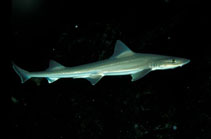
Etymology: Mustelus: Latin for weasel, an ancient name for sharks, possibly referring to the pointed snouts, swift movements and/or rapacious feeding behavior of smaller predatory sharks [strictly not tautonymous with Squalus mustelus Linnaeus 1758 since type was designated by the ICZN] (See ETYFish); asterias: Starry, referring to many small white spots on dorsal (upper) surface of body (See ETYFish).
Ambiente: milieu / zona climatica / distribuzione batimetrica / gamma di distribuzione
Ecologia
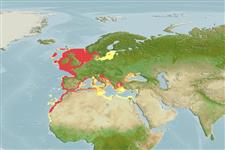
marino demersale; distribuzione batimetrica 0 - 350 m (Ref. 6808). Temperate; 61°N - 16°N, 19°W - 36°E
Northeast Atlantic: British Isles and North Sea to Canary Islands, including the Mediterranean and Mauritania.
Lunghezza alla prima maturità / Dimensione / Peso / Età
Maturità: Lm 81.0, range 85 - ? cm
Max length : 154 cm TL maschio/sesso non determinato; (Ref. 86318); peso massimo pubblicato: 4.8 kg (Ref. 4699)
A common inshore and offshore shark found on the continental and insular shelves from the intertidal down to at least 100 m. Prefers sandy and gravelly bottom. Feeds primarily on crustaceans (crabs, hermit crabs, lobsters and slipper lobsters). Ovoviviparous (aplacental), with 7 to 15 young per litter. Size at birth about 30 cm. Utilized fresh and dried salted.
Ovoviviparous, embryos feed solely on yolk (Ref. 50449).
Compagno, L.J.V., 1984. FAO Species Catalogue. Vol. 4. Sharks of the world. An annotated and illustrated catalogue of shark species known to date. Part 2 - Carcharhiniformes. FAO Fish. Synop. 125(4/2):251-655. Rome: FAO. (Ref. 244)
Stato della Lista Rossa IUCN (Ref. 130435: Version 2025-2 (Global))
Minaccia per l'uomo
Harmless
Usi umani
Pesca: commerciale; Pesce da pesca sportiva: si
Strumenti
Rapporti speciali
Scarica XML
Fonti Internet
Stime basate su modelli
Temperatura preferita (Fonte Biblio.
123201): 7 - 16.2, mean 10.1 °C (based on 587 cells).
Indice di diversità filogenetica (Fonte Biblio.
82804): PD
50 = 0.5000 [Uniqueness, from 0.5 = low to 2.0 = high].
Bayesian length-weight: a=0.00174 (0.00146 - 0.00207), b=3.13 (3.08 - 3.18), in cm total length, based on LWR estimates for this species (Ref.
93245).
Livello trofico (Fonte Biblio.
69278): 3.6 ±0.3 se; based on diet studies.
Generation time: 7.5 ( na - na) years. Estimated as median ln(3)/K based on 2
growth studies.
Resilienza (Fonte Biblio.
120179): Molto basso, tempo minimo di raddoppiamento della popolazione più di 14 anni (tm=2-3; Fec=7).
Vulnerabilità della pesca (Ref.
59153): High to very high vulnerability (71 of 100).
🛈
Vulnerabilità climatica (Ref.
125649): Moderate to high vulnerability (49 of 100).
🛈
Nutrienti (Ref.
124155): Calcium = 7.5 [2.7, 39.2] mg/100g; Iron = 0.16 [0.05, 0.62] mg/100g; Protein = 21.2 [18.8, 23.6] %; Omega3 = 0.236 [0.101, 0.548] g/100g; Selenium = 22.7 [7.0, 76.8] μg/100g; VitaminA = 6.69 [2.12, 20.78] μg/100g; Zinc = 0.428 [0.190, 0.861] mg/100g (wet weight);