Môi trường: môi trường / vùng khí hậu / Mức độ sâu / phạm vi phân phối
Sinh thái học
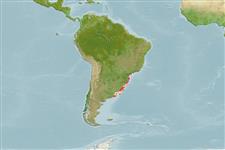
biển; thuộc về nước lợ gần đáy; mức độ sâu 3 - 13 m (Ref. 104557). Tropical; 23°S - 38°S (Ref. 104557)
Southwest Atlantic: from Rio de Janeiro, Brazil to Mar del Plata, Argentina.
Bộ gần gũi / Khối lượng (Trọng lượng) / Tuổi
Chín muồi sinh dục: Lm ? range ? - ? cm
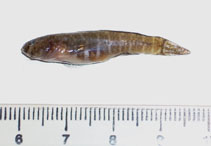
Max length : 4.4 cm TL con đực/không giới tính; (Ref. 104557)
Các tia vây lưng cứng (tổng cộng) : 8; Các vây lưng mềm (tổng cộng) : 10 - 11; Tia cứng vây hậu môn: 1; Tia mềm vây hậu môn: 8 - 9. This species is distinguished from its congeners by the following set of characters: body scaled from caudal peduncle to the base of pectoral fin, the scales wedge-shaped to under posterior of first dorsal-fin base, wedge ending abruptly, then continuing forward in a narrow, straight row of 1-2 scales high along midline; the naked area extending from mid- pectoral-fin base to (or past) posterior of second dorsal-fin base and from mid-pectoral-fin base to (or past) posterior end anal fin ray base; upper jaw 34.6 % in head length (HL); lateral scales modally 31; pectoral fin 19 (17-21) (Ref. 104557).
Body shape (shape guide): elongated; Cross section: oval.
The species occirs in estuarine, intertidal and shallow coastal areas and frequently found associated with epilithic organisms (2 centimeters or more in size) found at depths ranging from tidepools to 13 meters. Some specimens from Lagoa da Conceição (state of Santa Catarina) were collected while snorkeling along the granitic shores in 1.5 to 2 meters of water in an area where the non-native tunicate Styela plicata (Lesueur 1823) are found and this solitary ascidian forms extensive aggregations in bands about 1 meter below the lower limit of the intertidal zone. Other species collected in the area included: gobiid Bathygobius soporator (Valenciennes 1837), the native blenny Hypleurochilus fissicornis (Quoy & Gaimard 1824), the invasive blenny Omobranchus punctatus (Valenciennes 1836), and the gobiesocid Gobiesox barbatulus Starks 1913. In Mar Chiquita lagoon (Buenos Aires Province, Argentina) this species has been recorded in high numbers associated with the reefs built by the invasive tubeworm Ficopomatus enigmaticus (Fauvel 1923; also known as Mercierella enigmatica) (Cervigón & Bastida, 1971). Nearby in Mar del Plata, this species inhabits the encrusting community in both the harbor and the mesolittoral zone of Cabo Corrientes; where in the latter community, composed of the mussels Brachidontes rodriguezii (d'Orbigny 1842) and Mytilus edulis platensis d'Orbigny 1842, this species is rare. In Uruguay, it was observed in tidepools 20 and 50 cm deep with clear water and sandy bottoms (A. Carvalho-Filho, pers. comm., 17 May 2013); other fish species in the pools included: H. fissicornis, juveniles of Mugil curema Valenciennes 1836 and adults of Jenynsia multidentata (Jenyns 1842). In São Paulo, both this species and Barbulifer enigmaticuswere collected within the same tidepools (J.L. Figueiredo, pers. comm., 20 September 2010). In northern Argentina and southern Brazil, this species has been collected at 8-13 meters. Also this species uses the empty shells of the cultured mussel Perna perna (Linnaeus 1758) for spawning and is an intermediary host of Bucephalus margaritae (Ozaki & Ishibashi 1934), a trematode worm parasitic on the mussel, in Santa Catarina (Ref. 104557).
Vòng đời và hành vi giao phối
Chín muồi sinh dục | Sự tái sinh sản | Đẻ trứng | Các trứng | Sự sinh sản | Ấu trùng
Van Tassell, J.L., J.-C. Joyeux, R.M. Macieira and L. Tornabene, 2015. Status of Gobiosoma (Teleostei: Gobiidae) from Brazil: description of a new species, redescription of G. hemigymnum, molecular phylogeny of the genus, and key to Atlantic species. Zootaxa 4007(4):451-480. (Ref. 104557)
Tình trạng Sách đỏ IUCN (Ref. 130435: Version 2025-2 (Global))
Mối đe dọa đối với con người
Harmless
Sử dụng của con người
Các công cụ
Báo cáo đặc biệt
Tải xuống XML
Các nguồn internet
Ước tính dựa trên mô hình
Chỉ số đa dạng phát sinh loài (Tài liệu tham khảo
82804): PD
50 = 0.5000 [Uniqueness, from 0.5 = low to 2.0 = high].
Bayesian length-weight: a=0.00741 (0.00347 - 0.01582), b=3.09 (2.91 - 3.27), in cm total length, based on LWR estimates for this (Sub)family-body shape (Ref.
93245).
Mức dinh dưỡng (Tài liệu tham khảo
69278): 3.2 ±0.3 se; based on size and trophs of closest relatives
Thích nghi nhanh (Tài liệu tham khảo
120179): Chiêù cao, thời gian nhân đôi của chủng quần tối thiểu là dưới 15 tháng (Preliminary K or Fecundity.).
Sự dễ bị tổn thương của nghề đánh cá (Ref.
59153): Low vulnerability (10 of 100).
🛈