>
Gobiiformes (Gobies) >
Gobiidae (Gobies) > Gobiinae
Etymology: Fusigobius: Latin, fusus = spindle + Latin, gobius = gudgeon (Ref. 45335); gracilis: Named for its being the most slender among its congeners.
More on author: Randall.
Entorno: milieu / zona climática / rango de profundidad / gama de distribución
Ecología
marino demersal; rango de profundidad 6 - 18 m (Ref. 41649). Subtropical
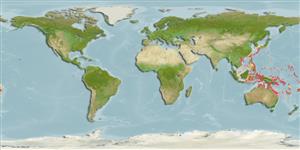
Western Pacific: Ryukyu Islands to the Great Barrier Reef and New Caledonia, east to Fiji.
Tamaño / Peso / Edad
Madurez: Lm ? range ? - ? cm
Max length : 4.2 cm SL macho / no sexado; (Ref. 41649); 3.0 cm SL (female)
Descripción breve
Claves de identificación | Morfología | Morfometría
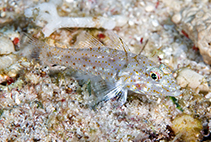
Espinas dorsales (total) : 7; Radios blandos dorsales (total) : 9; Espinas anales: 1; Radios blandos anales: 8; Vértebra: 26. Diagnosis: Dorsal rays VI - I,9. Anal rays 1,8. Pectoral rays 17-19 (usually 18). Longitudinal scale series 25. Head naked except for scales on side of nape reaching nearly to above upper end of preopercular margin; posterior nostril not close to orbit. The body is slender, depth 5.45-5.75 in SL; snout length 3.0-3.4 in head; first dorsal fin not higher than second; second dorsal spine usually longest, 5.35-5.8 in SL. Pelvic fins fully joined medially by membrane (when intact); pelvic frenum absent. Body translucent with numerous very small orange-yellow spots with blackish centers on head and body, those on head arranged in oblique rows; a black spot the size of pupil or smaller at midbase of caudal fin; a second smaller blackish spot just above base of pectoral fin; dorsal and caudal fins with orange-yellow spots; a dusky orange line from upper part of first membrane of first dorsal fin to base of second spine (Ref. 41649).
Body shape (shape guide): fusiform / normal.
Inhabits sand-rubble bottoms next to reefs in 6-18 m (Ref. 90102).
Ciclo vital y comportamiento de apareamiento
Madurez | Reproducción | Puesta | Huevos | Fecundidad | Larva
Randall, J.E., 2001. Five new Indo-Pacific gobiid fishes of the genus Coryphopterus. Zool. Stud. 40(3):206-225. (Ref. 41649)
Situación en la Lista Roja de la UICN (Ref. 130435: Version 2025-2 (Global))
Amenaza para el ser humano
Harmless
Usos humanos
Herramientas
Informes especiales
Descargar XML
Fuentes de Internet
Estimaciones basadas en modelos
Temperatura preferida (Referencia
123201): 24.9 - 29.3, mean 28.5 °C (based on 1509 cells).
Índice de diversidad filogenética (Referencia
82804): PD
50 = 0.5005 [Uniqueness, from 0.5 = low to 2.0 = high].
Bayesian length-weight: a=0.01023 (0.00477 - 0.02194), b=3.01 (2.83 - 3.19), in cm total length, based on LWR estimates for this (Sub)family-body shape (Ref.
93245).
Nivel trófico (Referencia
69278): 3.2 ±0.3 se; based on size and trophs of closest relatives
Resiliencia (Referencia
120179): Alto, población duplicada en un tiempo mínimo inferior a 15 meses (Preliminary K or Fecundity.).
Vulnerabilidad pesquera (Ref.
59153): Low vulnerability (10 of 100).
🛈