Elasmobranchi (squali e razze) (sharks and rays) >
Carcharhiniformes (Ground sharks) >
Triakidae (Houndsharks) > Triakinae
Etymology: Triakis: tri-, from tres (L.), three; akis (Gr.), point, referring to each tooth consisting of one large central cusp flanked on by both sides by a small cusplet (See ETYFish); megalopterus: mega-, from megas (Gr.), large; pterus (Gr.), fin, referring to its broad, large fins (See ETYFish).
More on author: Smith.
Ambiente: milieu / zona climatica / distribuzione batimetrica / gamma di distribuzione
Ecologia
marino demersale; distribuzione batimetrica 1 - 50 m (Ref. 5578). Subtropical; 30°S - 36°S
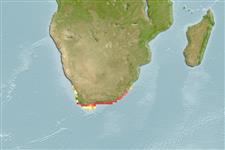
Southeast Atlantic: Namibia to Coffee Bay, South Africa.
Lunghezza alla prima maturità / Dimensione / Peso / Età
Maturità: Lm 145.0, range 140 - 150 cm
Max length : 142 cm TL maschio/sesso non determinato; (Ref. 244); 174.0 cm TL (female); peso massimo pubblicato: 20.0 kg (Ref. 5485)
Breve descrizione
Chiavi di identificazione | Morfologia | Morfometria
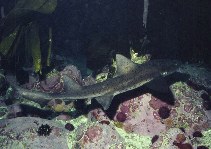
Spine dorsali (totale) : 0; Spine anali: 0. Blunt snout and a large mouth with small pointed teeth; caudal peduncle short and heavy (Ref. 5578). Grey with numerous black spots which may be sparse or absent in some specimens; new born pups with fewer black spots compared to adults (Ref. 5485); white below (Ref. 5578).
Body shape (shape guide): elongated.
Occurs off sandy beaches, rocky shores and in shallow bays (Ref. 5578). Feeds on crabs, lobsters, bony fish and small sharks (Ref. 5578). Ovoviviparous (Ref. 50449). Forms schools in summer (Ref. 244). Hardy and keeps well in captivity (Ref. 244). Commonly caught by rock and surf sports anglers but not eaten much (Ref. 244). Meat is dried into shark 'biltong' or jerky which commands a relatively high price (Ref. 244). Attains 160 cm, TL (Ref. 36731).
Ovoviviparous, embryos feed solely on yolk (Ref. 50449), with 6 to 12 young in a litter (Ref. 244). 30-32 cm at birth (Ref. 244).
Compagno, L.J.V., 1984. FAO Species Catalogue. Vol. 4. Sharks of the world. An annotated and illustrated catalogue of shark species known to date. Part 2 - Carcharhiniformes. FAO Fish. Synop. 125(4/2):251-655. Rome: FAO. (Ref. 244)
Stato della Lista Rossa IUCN (Ref. 130435: Version 2025-2 (Global))
Minaccia per l'uomo
Harmless
Usi umani
Pesca: scarso interesse commerciale; Pesce da pesca sportiva: si; Acquario: Acquari pubblici
Strumenti
Rapporti speciali
Scarica XML
Fonti Internet
Stime basate su modelli
Temperatura preferita (Fonte Biblio.
123201): 15.8 - 22.4, mean 19.3 °C (based on 26 cells).
Indice di diversità filogenetica (Fonte Biblio.
82804): PD
50 = 0.5312 [Uniqueness, from 0.5 = low to 2.0 = high].
Bayesian length-weight: a=0.00245 (0.00117 - 0.00517), b=3.14 (2.96 - 3.32), in cm total length, based on LWR estimates for this (Sub)family-body shape (Ref.
93245).
Livello trofico (Fonte Biblio.
69278): 4.0 ±0.5 se; based on diet studies.
Resilienza (Fonte Biblio.
120179): Molto basso, tempo minimo di raddoppiamento della popolazione più di 14 anni (Fec=6).
Vulnerabilità della pesca (Ref.
59153): Very high vulnerability (90 of 100).
🛈