>
Acanthuriformes (Surgeonfishes) >
Zanclidae (Moorish idol)
Etymology: Zanclus: Greek, za = an augmentative particle + Greek, agklino = to be on one´s back (Ref. 45335).
More on author: Linnaeus.
Environnement : milieu / zone climatique / profondeur / gamme de distribution
Écologie
marin récifal; profondeur 0 - 182 m (Ref. 9710), usually 5 - 182 m (Ref. 27115). Subtropical; 24°C - 28°C (Ref. 27115); 32°N - 37°S, 21°E - 70°W
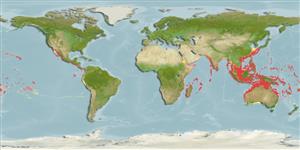
Indo-Pacific: East Africa to Rapa and Ducie islands, north to southern Japan and the Hawaiian Islands, south to the Lord Howe Island. Eastern Pacific: southern Gulf of California to Peru (Ref. 9267).
Taille / Poids / Âge
Maturité: Lm ? range ? - ? cm
Max length : 23.0 cm TL mâle / non sexé; (Ref. 6113); common length : 21.0 cm NG mâle / non sexé; (Ref. 5755)
Description synthétique
Clés d'identification | Morphologie | Morphométrie
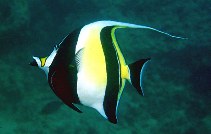
Épines dorsales (Total) : 6 - 7; Rayons mous dorsaux (Total) : 39 - 43; Épines anales: 3; Rayons mous anaux: 31 - 37. Strongly compressed discoid body. Tubular snout with a small mouth containing numerous elongate bristle-like teeth. Dorsal spines elongated into a whip-like filament.
Body shape (shape guide): short and / or deep; Cross section: compressed.
Adults inhabit turbid inner lagoons, reef flats, and clear seaward rocky and coral reefs (Ref. 1602, 48637). Benthopelagic (Ref. 58302). Generally encountered in small groups of 2 or 3 individuals (Ref. 9267). Adults occur singly, in pairs and occasionally are seen in large schools (Ref. 48637). They feed on small encrusting animals (Ref. 6113). Size of metamorphosis from postlarva to juvenile is 7.5 cm (Ref. 9267). The long pelagic larval stage is the reason for the wide distribution and strong colouration that shows no geographical variation (Ref. 48637). Popular aquarium fish but rarely survives in tanks (Ref. 1602). Minimum depth reported taken from Ref. 128797.
Cycle de vie et comportement reproducteur
Maturité | Reproduction | Frai | Œufs | Fécondité | Larves
Myers, R.F., 1991. Micronesian reef fishes. Second Ed. Coral Graphics, Barrigada, Guam. 298 p. (Ref. 1602)
Statut dans la liste rouge de l'IUCN (Ref. 130435: Version 2025-2 (Global))
Menace pour l'homme
Harmless
Utilisations par l'homme
Pêcheries: pêcheries vivrières; Aquarium: Commercial
Outils
Articles particuliers
Télécharger en XML
Sources Internet
Estimations basées sur des modèles
Température préférée (Réf.
123201): 20 - 29, mean 27.7 °C (based on 4016 cells).
Indice de diversité phylogénétique (Réf.
82804): PD
50 = 1.5000 [Uniqueness, from 0.5 = low to 2.0 = high].
Bayesian length-weight: a=0.01738 (0.00674 - 0.04483), b=3.06 (2.84 - 3.28), in cm total length, based on LWR estimates for this (Sub)family-body shape (Ref.
93245).
Niveau trophique (Réf.
69278): 2.5 ±0.00 se; based on food items.
Vulnérabilité de la pêche (Ref.
59153): Low vulnerability (13 of 100).
🛈
Nutriments (Ref.
124155): Calcium = 44.8 [19.5, 73.0] mg/100g; Iron = 0.697 [0.404, 1.262] mg/100g; Protein = 18.8 [17.5, 20.0] %; Omega3 = 0.175 [0.095, 0.315] g/100g; Selenium = 22.8 [10.2, 47.4] μg/100g; VitaminA = 29.5 [6.8, 126.5] μg/100g; Zinc = 1.05 [0.66, 1.62] mg/100g (wet weight);