>
Eupercaria/misc (Various families in series Eupercaria) >
Labridae (Wrasses) > Cirrhilabrinae
Etymology: Cirrhilabrus: Latin, cirrus = curl fringe + Greek, labros = furious (Ref. 45335); earlei: Named in honor of John L. Earle who collected the holotype.
Eponymy: John L Earle is a founder member of the Association for Marine Exploration. [...] (Ref. 128868), visit book page.
More on authors: Randall & Pyle.
Environnement : milieu / zone climatique / profondeur / gamme de distribution
Écologie
marin récifal; profondeur 60 - 110 m (Ref. 41654). Tropical
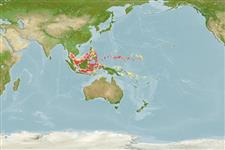
Western Central Pacific: Palau and Micronesia.
Longueur à la première maturité / Taille / Poids / Âge
Maturité: Lm ?, range 5 - ? cm
Max length : 6.9 cm SL mâle / non sexé; (Ref. 41654)
Description synthétique
Clés d'identification | Morphologie | Morphométrie
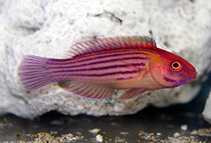
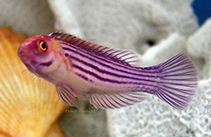
Épines dorsales (Total) : 11; Rayons mous dorsaux (Total) : 9; Épines anales: 3; Rayons mous anaux: 9; Vertèbres: 25. This species is distinguished by the following characters: D XI,9; A III,9; pectoral fin rays 15; dorsal fin with progressively longer spine where the 11th is 2.4-2.6 in head; in males the interspinous membranes do not extend above the spine tips; pelvic fins of male short 4.05-4.9 in SL; rounded to rhomboid caudal fin; lateral line scales 16-17 + 5-6; median predorsal scales 4-5; cheeks with 2 horizontal rows of scales; colour in life pale red, shading to pale yellow on abdomen, with deep red longitudinal lines on body following scale rows (persists as lavender to purple when preserved); head with two deep pink bands, one from upper lip passing over eye to origin of dorsal fin, the other from lower lip along mandible to corner or preopercle; operculum yellow; dorsal fin yellow anteriorly with a black spot on first membrane, spines red; rest of fin and caudal fin light red with deep red rays; pelvic fins yellow with red spines and rays (Ref. 41654).
Body shape (shape guide): fusiform / normal; Cross section: compressed.
Inhabits mixed coral, rubble, and sand slopes along the bases of steep protected seaward reefs (Ref. 37816). Maximum depth reported taken from Ref. 128797.
Cycle de vie et comportement reproducteur
Maturité | Reproduction | Frai | Œufs | Fécondité | Larves
Distinct pairing during breeding (Ref. 205).
Randall, J.E. and R.L. Pyle, 2001. Three new species of labrid fishes of the genus Cirrhilabrus from islands of the tropical Pacific. aqua, J. Ichthyol. Aquat. Biol. 4(3):89-98. (Ref. 41654)
Statut dans la liste rouge de l'IUCN (Ref. 130435: Version 2025-2 (Global))
Menace pour l'homme
Harmless
Utilisations par l'homme
Outils
Articles particuliers
Télécharger en XML
Sources Internet
Estimations basées sur des modèles
Température préférée (Réf.
123201): 12.6 - 28.5, mean 23 °C (based on 8 cells).
Indice de diversité phylogénétique (Réf.
82804): PD
50 = 0.5000 [Uniqueness, from 0.5 = low to 2.0 = high].
Bayesian length-weight: a=0.01072 (0.00427 - 0.02691), b=3.03 (2.81 - 3.25), in cm total length, based on LWR estimates for this (Sub)family-body shape (Ref.
93245).
Niveau trophique (Réf.
69278): 3.3 ±0.4 se; based on size and trophs of closest relatives
Résilience (Réf.
120179): Haut, temps minimum de doublement de population inférieur à 15 mois (Preliminary K or Fecundity.).
Vulnérabilité de la pêche (Ref.
59153): Low vulnerability (10 of 100).
🛈