>
Anguilliformes (Eels and morays) >
Ophichthidae (Snake eels) > Ophichthinae
Etymology: Brachysomophis: Greek, brachys, eia = short + Greek, soma = body + Greek, ophis = serpent (Ref. 45335); henshawi: Named for Henry W. Henshaw.
Eponymy: Henry Wetherbee Henshaw (1850–1930) was a naturalist, ornithologist and ethnologist. [...] (Ref. 128868), visit book page.
More on authors: Jordan & Snyder.
Entorno: milieu / zona climática / rango de profundidad / gama de distribución
Ecología
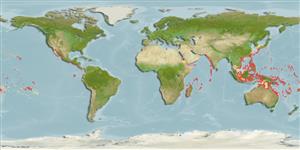
marino asociado a arrecife; rango de profundidad 1 - 35 m (Ref. 42180). Tropical
Indo-Pacific.
Tamaño / Peso / Edad
Madurez: Lm ? range ? - ? cm
Max length : 120 cm TL macho / no sexado; (Ref. 89972)
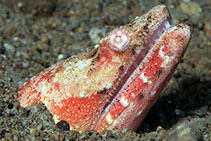
Vértebra: 128 - 134. With tail 45-48% and head 13-16% of TL; dorsal fin arising well behind pectoral tips; pectoral fins fan-shaped, not elongate; snout short, about 3.4 in jaw; jaws elongate, about 2.3-3 in head; nostrils in short tubes in upper lip and closely associated; cirri of labial fringe unbranched, short and stubby; flesh above and behind eye laterally elevated as a ridge; dorsal head profile depressed and constricted behind eyes, the flesh forming a lateral eave behind dorsal margin of eye; head pores and lateral-line pores apparent; free sensory neuromasts visible as rows of white spots on nape; teeth conical; coloration in life variable; fins pale except dorsal notably dark basally with a pale margin; lateral-line pores in distinct dark spots; numerous dark spots above lateral line on body (Ref. 42180).
Body shape (shape guide): eel-like; Cross section: circular.
Found over sandy areas, usually near or within coral or rocky reefs (Ref. 42180, 75154). Feeds on fishes and crtustaceans (Ref. 89972). Benthic (Ref. 58302, 75154). At night, it is usually encountered with its head and even the anterior portion of its body protruding from the substrate at night (Ref. 42180). At day time, it often remains buried with only the tip of its snout and the top of its head projecting from the sand or mud (Ref. 42180).
Ciclo vital y comportamiento de apareamiento
Madurez | Reproducción | Puesta | Huevos | Fecundidad | Larva
McCosker, J.E. and J.E. Randall, 2001. Revision of the snake-eel genus Brachysomophis (Anguilliformes: Ophichthidae), with description of two new species and comments on the species of Mystriophis. Indo-Pac. Fish. (33):1-32. (Ref. 42180)
Situación en la Lista Roja de la UICN (Ref. 130435: Version 2025-2 (Global))
Amenaza para el ser humano
Harmless
Usos humanos
Pesquerías: pesquerías de subsistencia
Herramientas
Informes especiales
Descargar XML
Fuentes de Internet
Estimaciones basadas en modelos
Temperatura preferida (Referencia
123201): 24.6 - 29.3, mean 28 °C (based on 2349 cells).
Índice de diversidad filogenética (Referencia
82804): PD
50 = 0.5078 [Uniqueness, from 0.5 = low to 2.0 = high].
Bayesian length-weight: a=0.00093 (0.00041 - 0.00214), b=2.99 (2.79 - 3.19), in cm total length, based on LWR estimates for this (Sub)family-body shape (Ref.
93245).
Nivel trófico (Referencia
69278): 4.0 ±0.6 se; based on size and trophs of closest relatives
Resiliencia (Referencia
120179): Medio, población duplicada en un tiempo mínimo de 1.4-4.4 años (Preliminary K or Fecundity.).
Vulnerabilidad pesquera (Ref.
59153): High to very high vulnerability (72 of 100).
🛈