>
Lophiiformes (Anglerfishes) >
Oneirodidae (Dreamers)
Etymology: Oneirodes: Greek, 'oneiros' = a dream or dreamlike or out of a dream (suggesting this fish is so strange and marvelous that can exist only in dreams) (Ref. 86949).
More on authors: Regan & Trewavas.
Ambiente: milieu / zona climatica / distribuzione batimetrica / gamma di distribuzione
Ecologia
marino batipelagico; distribuzione batimetrica ? - 1500 m (Ref. 36336). Deep-water
Indian Ocean.
Dimensione / Peso / Età
Maturità: Lm ? range ? - ? cm
Max length : 3.2 cm SL maschio/sesso non determinato; (Ref. 36336)
Breve descrizione
Chiavi di identificazione | Morfologia | Morfometria
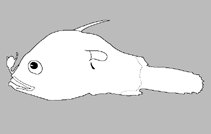
Raggi dorsali molli (totale) : 6; Raggi anali molli: 4. Characterized by having escal morphology: esca with a stout anterior appendage, shorter than escal bulb, without internal pigment, bearing a single short branch; pair of unpigmented filamentous medial escal appendages, slightly longer than escal appendage; rounded terminal escal papilla with a distal spot of pigment; an anteroposteriorly compressed, unpigmented posterior escal appendage, as long as escal bulb, bearing 2 short branches at midlength; absence of lateral escal appendages; two pairs of filamentous anterolateral escal appendages; inner pair of stout, tapering appendages flanking anterior appendage each longer than SL, lightly pigmented internally except for slightly expanded distal tip, and bearing numerous short filaments, and an outer pair of unpigmented bifurcated appendages, each tapering branch of which is more than three times length of escal bulb and bears two short filaments; long and narrow subopercle, dorsal end tapering, rounded distally, without indentation on posterodorsal margin; length of ventral fork of opercle 23.8% SL; ratio of lengths of the dorsal and ventral forks of opercle 0.50; absence of epibranchial teeth; presence of teeth on pharyngobranchial II; upper jaw teeth 33, lower jaw teeth 49; teeth on vomer 6; dorsal fin rays 6; anal fin rays 4; pectoral fin rays 16; head length 40.4% SL; head depth 47.6% SL; premaxilla length 35.7% SL; length of lower jaw 47.6% SL; length of illicium 33.3% SL (Ref. 86949).
Minimum depth from Ref. 58018.
Ciclo vitale e comportamento di accoppiamento
Maturità | Riproduzione | Deposizione | Uova | Fecondità | Larve
Orr, J.W., 1991. A new species of the ceratioid anglerfish genus Oneirodes (Oneirodidae) from the western North Atlantic, with a revised key to the genus. Copeia 1991(4):1024-1031. (Ref. 36336)
Stato della Lista Rossa IUCN (Ref. 130435: Version 2025-2 (Global))
Minaccia per l'uomo
Harmless
Usi umani
Strumenti
Rapporti speciali
Scarica XML
Fonti Internet
Stime basate su modelli
Indice di diversità filogenetica (Fonte Biblio.
82804): PD
50 = 0.5000 [Uniqueness, from 0.5 = low to 2.0 = high].
Bayesian length-weight: a=0.01995 (0.00906 - 0.04395), b=3.01 (2.83 - 3.19), in cm total length, based on all LWR estimates for this body shape (Ref.
93245).
Livello trofico (Fonte Biblio.
69278): 3.3 ±0.6 se; based on size and trophs of closest relatives
Resilienza (Fonte Biblio.
120179): Alto, tempo minimo di raddoppiamento della popolazione meno di 15 mesi (Preliminary K or Fecundity.).
Vulnerabilità della pesca (Ref.
59153): Low vulnerability (10 of 100).
🛈