>
Syngnathiformes (Pipefishes and seahorses) >
Syngnathidae (Pipefishes and seahorses) > Nerophinae
Etymology: Doryrhamphus: Greek, dory = lance + Greek, rhamphos = bill, beak (Ref. 45335).
More on author: Kaup.
Ambiente: milieu / zona climatica / distribuzione batimetrica / gamma di distribuzione
Ecologia
marino associati a barriera corallina; non migratori (Ref. 52884); distribuzione batimetrica 2 - 50 m (Ref. 30874). Tropical; 30°N - 32°S
Indo-Pacific and Eastern Pacific: Persian Gulf and East Africa to the west coast of the Americas. It was noted by Dawson (Ref. 5316) that there is a clinal increase in the number of total rings and dorsal rays for the 3 subspecies (Red Sea, D. e. abbreviatus and Eastern Pacific D. e. paulus (Ref. 86689).
Dimensione / Peso / Età
Maturità: Lm ? range ? - ? cm
Max length : 7.0 cm TL maschio/sesso non determinato; (Ref. 9710)
Breve descrizione
Chiavi di identificazione | Morfologia | Morfometria
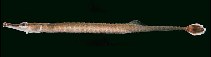
Spine dorsali (totale) : 0; Raggi dorsali molli (totale) : 21 - 29; Spine anali: 0; Raggi anali molli: 4. Superior trunk and tail ridges discontinuous; inferior trunk ridge ending on anal ring; lateral trunk ridge continuous with inferior tail ridge; body rings 17-19; tail rings 13-17. Also Ref. 4281.
Body shape (shape guide): eel-like; Cross section: angular.
Uncommon, cryptic species (Ref. 5227), prefers crevices in rocks and corals and areas beneath ledges (Ref. 28023). Occurs in lagoon and seaward reefs to a depth of 45 m or more (Ref. 9710). Benthopelagic (Ref. 58302). Often seen in pairs. Uses its tubelike snout to ingest small crustaceans and plankton (Ref. 28023). Ovoviviparous (Ref. 205). The male carries the eggs in a brood pouch which is found under the tail (Ref. 205). Monogamous and always in home-ranging pairs, that is they do not defend an exclusive territory (Ref. 52884).
Ciclo vitale e comportamento di accoppiamento
Maturità | Riproduzione | Deposizione | Uova | Fecondità | Larve
Monogamous mating is observed as both obligate and genetic (Ref. 52884). Male carries the eggs in a brood pouch (Ref. 205).
Stiller, J., G. Short, H. Hamilton, N. Saarman, S. Longo, P. Wainwright, G.W. Rouse and W.B. Simison, 2022. Phylogenomic analysis of Syngnathidae reveals novel relationships, origins of endemic diversity and variable diversification rates. BMC Biology 20 (art. 75):1-22. [New family-group names in Additional file 1.] (Ref. 127687)
Stato della Lista Rossa IUCN (Ref. 130435: Version 2025-2 (Global))
Minaccia per l'uomo
Harmless
Usi umani
Pesca: commerciale; Acquario: Commerciale
Strumenti
Rapporti speciali
Scarica XML
Fonti Internet
Stime basate su modelli
Temperatura preferita (Fonte Biblio.
123201): 24.7 - 29, mean 27.7 °C (based on 800 cells).
Indice di diversità filogenetica (Fonte Biblio.
82804): PD
50 = 0.5010 [Uniqueness, from 0.5 = low to 2.0 = high].
Bayesian length-weight: a=0.00123 (0.00063 - 0.00239), b=3.09 (2.91 - 3.27), in cm total length, based on LWR estimates for this species & (Sub)family-body (Ref.
93245).
Livello trofico (Fonte Biblio.
69278): 3.5 ±0.44 se; based on food items.
Resilienza (Fonte Biblio.
120179): Alto, tempo minimo di raddoppiamento della popolazione meno di 15 mesi (Preliminary K or Fecundity.).
Vulnerabilità della pesca (Ref.
59153): Low vulnerability (10 of 100).
🛈
Nutrienti (Ref.
124155): Calcium = 185 [102, 389] mg/100g; Iron = 1.21 [0.67, 2.13] mg/100g; Protein = 17.4 [16.2, 18.7] %; Omega3 = 0.13 [0.07, 0.26] g/100g; Selenium = 32.9 [15.0, 83.3] μg/100g; VitaminA = 173 [55, 534] μg/100g; Zinc = 2.25 [1.44, 3.27] mg/100g (wet weight);