>
Cichliformes (Cichlids, convict blennies) >
Cichlidae (Cichlids) > Pseudocrenilabrinae
Etymology: Hemichromis: Greek, hemis = half + Greek, chromis = a fish, perhaps a perch (Ref. 45335).
More on author: Guichenot.
पर्यावरण: पर्यावरण / जलवायु क्षेत्र / गहराई सीमा / वितरण सीमा
पारिस्थितिकी
; स्वच्छ जल, अलवण जल बेनथोपिलाजिक; pH range: ? - 7.0; dH range: ? - 15; गैर प्रवासी (Ref. 126106). Tropical; 23°C - 25°C (Ref. 2060)
Africa: widely distributed in the coastal rivers of Lower Guinea, from the Ntem in Cameroon to Kouilou basin in Republic of Congo, including the Woleu, Ogowe and Nyanga rivers (Ref. 81260, 123791). Also in the Dja River, an affluent of the Middle Congo basin (Ref. 123791). Populations from entire Congo River basin and southern African basins, including Okavango, Zambesi and Cuanza (Ref. 11970, 120641), are also considered as conspecific (Ref. 123791), and may represent a distinct species (Ref. 81260). Also reported from West Africa in Guinea, Sierra Leone, Liberia, Togo, Benin and Nigeria (Ref. 43352, 81260), but this needs confirmation (Ref. 53405).
प्रथम परिपक्वता पर लंबाई / आकार / वज़न / आयु
परिपक्व अवधि: Lm 10.7, range 10 - 11.5 cm
Max length : 18.7 cm SL पुल्लिंग / अलिंग; (Ref. 81260)
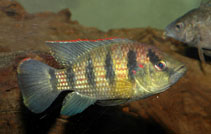
पृष्ठीय रीढ़ (सम्पूर्ण) : 13 - 16; पृष्ठीय सौफट रेज़ (सम्पूर्ण) : 11 - 13; गुदा कांटा: 3; ऐनल सौफट रेज़: 7 - 10. Diagnosis: Hemichromis elongatus can be distinguished from H. camerounensis by the presence of a single red opercular spot or a mixture of reddish and yellowish spots dorsally of the large black opercular spot instead of two red opercular spots on the both sides of the black spot in H. camerounensis (Ref. 123791). It can be distinguished from H. fasciatus by the absence of small black dots between the first three dark stripes on the sides of the body of adults (Ref. 123791). With 4-5 distinct blotches or ovoid bars along lateral mid-line (Ref. 44091, 81260), but bands not obvious in large males which assume a very dark to almost black coloration (Ref. 44091). Scales olive to yellow; series of thin red dots often forming horizontal lines along the mid-portion of flanks; normally 2 rows of teeth on upper jaw (Ref. 81260). Magenta spot on gill cover (Ref. 44091).
Body shape (shape guide): fusiform / normal.
Adults are found in shallow lakes and streams (Ref. 58302). Highly predaceous and thus used in some areas for tilapia control; feeds on fish, shrimp and aquatic insects; very aggressive and territorial (Ref. 44091); Parents guard the nest and larvae (Ref. 7248). Pair-bonding, substrate brooder (Ref. 81260). Oviparous (Ref. 205).
Daget, J. and G.G. Teugels, 1991. Hemichromis. p. 187-194. In J. Daget, J.-P. Gosse, G.G. Teugels and D.F.E. Thys van den Audenaerde (eds.) Check-list of the freshwater fishes of Africa, CLOFFA, ISNB, Brussels; MRAC, Tervuren; and ORSTOM, Paris. Vol. 4. (Ref. 5644)
आईयूसीएन रेड लिस्ट स्थिति (Ref. 130435: Version 2025-2 (Global))
मनुष्यों के लिए ख़तरा
Harmless
मानव उपयोग
साधन
विशेष रिपोर्ट
XML डाउनलोड करें
इंटरनेट स्रोत
मॉडल पर आधारित अनुमान
जातिवृति विविधता सूचकांक (संदर्भ
82804): PD
50 = 0.5625 [Uniqueness, from 0.5 = low to 2.0 = high].
Bayesian length-weight: a=0.01778 (0.00958 - 0.03300), b=3.02 (2.87 - 3.17), in cm total length, based on LWR estimates for this species & (Sub)family-body (Ref.
93245).
ट्रॉफिक स्तर (संदर्भ
69278): 3.7 ±0.58 se; based on food items.
लौटाव (संदर्भ
120179): ऊंचा, न्यूनतम जनसंख्या दुगनी समय अवलागत 15 महीने। (tm<1; Fec=500).
मछली पकड़ने की भेद्यता (Ref.
59153): Low vulnerability (13 of 100).
🛈
पोषक तत्व (Ref.
124155): Calcium = 145 [78, 271] mg/100g; Iron = 1.41 [0.78, 2.70] mg/100g; Protein = 18.5 [17.1, 20.0] %; Omega3 = 0.539 [0.201, 1.522] g/100g; Selenium = 61.7 [25.0, 155.9] μg/100g; VitaminA = 68.4 [16.0, 211.8] μg/100g; Zinc = 2.03 [1.36, 3.09] mg/100g (wet weight);