Environnement : milieu / zone climatique / profondeur / gamme de distribution
Écologie
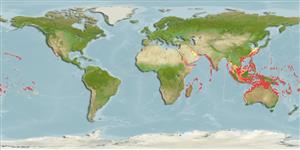
marin récifal; profondeur 1 - 113 m (Ref. 90102). Tropical; 33°N - 34°S, 32°E - 109°W
Indo-Pacific: Red Sea, East Africa, Comoro Islands and Mascarenes, east to the Hawaiian Islands, Line Islands and Pitcairn Group, north to southern Japan, south to Joseph Bonaparte Gulf (northern in front of Western Australia), New South Wales (Australia), Lord Howe, Norfolk, Kermadec Islands, New Caledonia, Tonga and Gambier Islands (Ref. 86817). Reported from Easter Island (Ref. 89467). Records from Eastern Pacific in Mexico and Panama need further confirmation.
Longueur à la première maturité / Taille / Poids / Âge
Maturité: Lm 24.0, range 21 - ? cm
Max length : 39.8 cm FL mâle / non sexé; (Ref. 125599); common length : 25.0 cm TL mâle / non sexé; (Ref. 30573); poids max. publié: 1.1 kg (Ref. 125599)
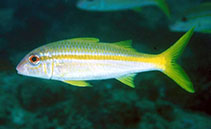
Épines dorsales (Total) : 8; Rayons mous dorsaux (Total) : 9; Épines anales: 1; Rayons mous anaux: 7. Back red-orange, sides and belly whitish; yellow longitudinal band present; no dark blotch on under middle of 1st dorsal fin (Ref. 5405). All fins yellow (Ref. 48636). Head length 2.9-3.4 in SL, length of snout 2.2.-2.6 and barbel 1.2-1.5 in HL. Body depth 3.4-4.5 in SL. (Ref. 90102)
Body shape (shape guide): fusiform / normal; Cross section: oval.
This occasionally schooling species inhabits sandy bottoms of reef flats, lagoons, coastal and seaward reefs (Ref. 9710, 90102). Benthopelagic (Ref. 58302). In large inactive aggregations by day, dispersing to sand flats to feed at night (Ref. 9710). Sometimes mixes with blue-striped snapper Lutjanus kasmira and shows blue stripes (Ref. 48636). Feeds on small worms and crustaceans. Also caught using ringnets (Ref. 5213). Minimum depth reported taken from Ref. 30874.
Cycle de vie et comportement reproducteur
Maturité | Reproduction | Frai | Œufs | Fécondité | Larves
Myers, R.F., 1991. Micronesian reef fishes. Second Ed. Coral Graphics, Barrigada, Guam. 298 p. (Ref. 1602)
Statut dans la liste rouge de l'IUCN (Ref. 130435: Version 2025-2 (Global))
Menace pour l'homme
Harmless
Utilisations par l'homme
Pêcheries: commercial; pêche sportive: oui
Outils
Articles particuliers
Télécharger en XML
Sources Internet
Estimations basées sur des modèles
Température préférée (Réf.
123201): 24.3 - 28.9, mean 27.7 °C (based on 1376 cells).
Indice de diversité phylogénétique (Réf.
82804): PD
50 = 0.5078 [Uniqueness, from 0.5 = low to 2.0 = high].
Bayesian length-weight: a=0.01023 (0.00888 - 0.01180), b=3.09 (3.05 - 3.13), in cm total length, based on LWR estimates for this species (Ref.
93245).
Niveau trophique (Réf.
69278): 3.9 ±0.44 se; based on food items.
Résilience (Réf.
120179): Milieu, temps minimum de doublement de population : 1,4 à 4,4 années (K=0.20-0.97; tmax=5;).
Vulnérabilité de la pêche (Ref.
59153): Low vulnerability (24 of 100).
🛈
Nutriments (Ref.
124155): Calcium = 54.8 [29.5, 90.0] mg/100g; Iron = 0.594 [0.271, 0.987] mg/100g; Protein = 18.9 [17.1, 20.5] %; Omega3 = 0.173 [0.115, 0.318] g/100g; Selenium = 42 [25, 73] μg/100g; VitaminA = 62.3 [21.7, 216.6] μg/100g; Zinc = 1.04 [0.66, 1.46] mg/100g (wet weight);