>
Petromyzontiformes (Lampreys) >
Petromyzontidae (Northern lampreys) > Lampetrinae
Etymology: Lethenteron: Etymology not explained, perhaps lethalis (L.), lethal, or lethe (Gr.), forgetting or forgetfulness; enteron (Gr.) intestine, presumably referring to “degenerate and non-functional” intestine of adult L. appendix (See ETYFish); alaskense: -ensis, Latin suffix denoting place: Alaska (USA), where type locality (West Creek, a tributary of Brooks Lake) is situated (See ETYFish).
Taxonomic Remarks
Provisionally considered to be a junior synonym of Lethenteron kessleri (Anikin, 1905) (in Ref. 125650).
Môi trường: môi trường / vùng khí hậu / Mức độ sâu / phạm vi phân phối
Sinh thái học
; nước ngọt gần đáy; di cư trong nước ngọt (Ref. 43939). Temperate
North America: Alaska and Kenai peninsulas to Chatanika and Chena rivers near Fairbanks; Martin River, Mackenzie River basin, Northwest Territories.
Bộ gần gũi / Khối lượng (Trọng lượng) / Tuổi
Chín muồi sinh dục: Lm ? range ? - ? cm
Max length : 18.8 cm TL con đực/không giới tính; (Ref. 43939)
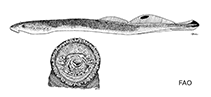
Adult preserved specimens gray-brown dorsally, white ventrally, with a dark blotch on 2nd dorsal fin; tail dark. Teeth on disk blunt and weakly cornified. Tongue teeth poorly developed and blunt. Typical length 12-17 cm TL (Ref. 43939). Trunk myomeres 66-72 (Ref. 43938, 89241). Other adult diagnostic features: 12.2-18.8 cm TL. Body proportions, as percentage of TL (based on 68 specimens measuring 12.2-18.8 cm TL): prebranchial length, 9.3-14.9; branchial length, 8.7?11.6; trunk length, 45.4-53.5; tail length, 25.7-33.5; eye length, 1.7-3.2; disc length, 3.8-7.3. Urogenital papilla length, as a percentage of branchial length, in a 14.1 cm TL spawning male, 26.9. The shape of the second dorsal fin in spawning males is arch-like and in females triangular. Dentition: supraoral lamina, 2 unicuspid teeth (1 of 34 specimens had 2 additional small unicuspid teeth on the bridge); infraoral lamina, 6-11 teeth, the lateralmost one on each side unicuspid or bicuspid and the internal ones unicuspid; 3 endolaterals on each side; endolateral formula, 2-2-2; 3 rows of anterials; first row of anterials, 3-5 unicuspid teeth; total number of anterials, 23-38 unicuspid teeth; exolaterals absent or one or two unicuspid exolaterals present in each lateral field, exceptionally, one complete row of exolaterals on each side; single row of posterials, 17-24 unicuspid teeth; transverse lingual lamina, 9-15 unicuspid teeth, the median one greatly enlarged; longitudinal lingual laminae each with 6-13 unicuspid teeth. Velar tentacles, 5-7, with tubercles and with the single median tentacle shorter than the lateral tentacles immediately next to it. Body coloration (preserved) in mature adults is gray brown on the upper surface and flanks and whitish on the lower surface. Lateral line neuromasts unpigmented. Gular region unpigmented (2 of 64 specimens had weak pigmentation). Second dorsal fin with a dark blotch near the apex (4 of 64 specimens did not have a blotch). Extent of caudal fin pigmentation, 1% to <25% (17% of specimens), 25% to <75% (36%) or, 75% or more (46%). Caudal fin shape, spade-like. Oral papillae, 18 (Ref. 89241).
Body shape (shape guide): eel-like.
Freshwater, in creeks and rivers (Ref. 89241). A non-parasitic lamprey. At about 4 years of age transforms from ammocoete in fall, moves downstream into lakes over winter; spawns the following spring and summer in shallow of lakes and rivers (Ref. 43939). Spawning period between 11 June and 25 September in Naknek River Basin, Alaska. Fecundity, 2,188-3,477 eggs/female. Egg length, 0.9 mm (Ref. 89241).
Mecklenburg, C.W., T.A. Mecklenburg and L.K. Thorsteinson, 2002. Fishes of Alaska. American Fisheries Society, Bethesda, Maryland. xxxvii +1037 p. (Ref. 43939)
Tình trạng Sách đỏ IUCN (Ref. 130435: Version 2025-2 (Global))
Mối đe dọa đối với con người
Harmless
Sử dụng của con người
Các công cụ
Báo cáo đặc biệt
Tải xuống XML
Các nguồn internet
Ước tính dựa trên mô hình
Chỉ số đa dạng phát sinh loài (Tài liệu tham khảo
82804): PD
50 = 0.5020 [Uniqueness, from 0.5 = low to 2.0 = high].
Bayesian length-weight: a=0.00132 (0.00060 - 0.00290), b=2.99 (2.80 - 3.18), in cm total length, based on LWR estimates for this (Sub)family-body shape (Ref.
93245).
Mức dinh dưỡng (Tài liệu tham khảo
69278): 3.1 ±0.4 se; based on size and trophs of closest relatives
Thích nghi nhanh (Tài liệu tham khảo
120179): thấp, thời gian nhân đôi của chủng quần tối thiểu là 4.5 - 14 năm (tm=tmax=5).
Sự dễ bị tổn thương của nghề đánh cá (Ref.
59153): Low vulnerability (10 of 100).
🛈