>
Mulliformes (Goatfishes) >
Mullidae (Goatfishes)
Etymology: Parupeneus: Latin, parum, parvum = small + Peneus, the name of a river.
More on author: Lacepède.
Taxonomic Remarks
Included in the Parupeneus trifasciatus complex are: Parupeneus trifasciatus, Indian Ocean; Parupeneus crassilabris, from eastern Indian Ocean to western Pacific, east to Fiji, Tonga, and Caroline Islands; Parupeneus insularis, the more eastern islands of Oceania.
Entorno: milieu / zona climática / rango de profundidad / gama de distribución
Ecología
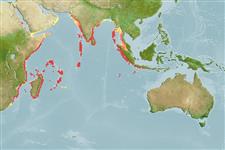
marino asociado a arrecife; rango de profundidad 0 - 80 m (Ref. 1602). Tropical; 24°N - 33°S, 28°E - 112°E
Indian Ocean: Oman and East Africa south to South Africa and east to Christmas Island and Java, Indonesia.
Tamaño / Peso / Edad
Madurez: Lm ? range ? - ? cm
Max length : 35.0 cm TL macho / no sexado; (Ref. 30573); common length : 27.0 cm TL macho / no sexado; (Ref. 30573); peso máximo publicado: 656.00 g (Ref. 125599)
Espinas dorsales (total) : 8; Radios blandos dorsales (total) : 9; Espinas anales: 1; Radios blandos anales: 7.
Body shape (shape guide): fusiform / normal; Cross section: oval.
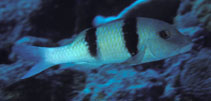
This occasionally schooling species inhabits lagoon and seaward reefs: juveniles on reef flats, adults tend to occur around rocky or coralline areas of high vertical relief. Feeds on crustaceans at daytime and on fishes and crab larvae at night. Also feeds on worms (Ref. 6113). Occurs in 3 color forms. The Indian Ocean form has 2 sharply defined wedge-shaped bars become narrower and sometimes end on the belly. The Indo-Australian form has 3 very distinct dark patches and rows of yellow spots on the sides. The Pacific Plate form has 2 wide bars that extend to the belly (Ref. 37816). Minimum depth reported taken from Ref. 128797.
Ciclo vital y comportamiento de apareamiento
Madurez | Reproducción | Puesta | Huevos | Fecundidad | Larva
Randall, J.E. and R.F. Myers, 2002. Parupeneus insularis, a new central pacific species of goatfish (Perciformes:Mullidae) of the P. trifasciatus complex. Zool. Stud. 41(4):431-440. (Ref. 45589)
Situación en la Lista Roja de la UICN (Ref. 130435: Version 2025-2 (Global))
Amenaza para el ser humano
Harmless
Usos humanos
Pesquerías: comercial
Herramientas
Informes especiales
Descargar XML
Fuentes de Internet
Estimaciones basadas en modelos
Temperatura preferida (Referencia
123201): 23.6 - 29, mean 27.8 °C (based on 1364 cells).
Índice de diversidad filogenética (Referencia
82804): PD
50 = 0.5000 [Uniqueness, from 0.5 = low to 2.0 = high].
Bayesian length-weight: a=0.00813 (0.00542 - 0.01220), b=3.18 (3.06 - 3.30), in cm total length, based on LWR estimates for this species & Genus-body shape (Ref.
93245).
Nivel trófico (Referencia
69278): 3.5 ±0.50 se; based on food items.
Resiliencia (Referencia
120179): Medio, población duplicada en un tiempo mínimo de 1.4-4.4 años (Preliminary K or Fecundity.).
Vulnerabilidad pesquera (Ref.
59153): Low vulnerability (25 of 100).
🛈
Nutrientes (Ref.
124155): Calcium = 33.2 [16.8, 74.0] mg/100g; Iron = 0.307 [0.155, 0.679] mg/100g; Protein = 17.9 [14.5, 20.9] %; Omega3 = 0.128 [0.073, 0.231] g/100g; Selenium = 56 [27, 128] μg/100g; VitaminA = 195 [39, 810] μg/100g; Zinc = 0.531 [0.319, 1.009] mg/100g (wet weight); based on
nutrient studies.