>
Mulliformes (Goatfishes) >
Mullidae (Goatfishes)
Etymology: Parupeneus: Latin, parum, parvum = small + Peneus, the name of a river.
More on author: Bennett.
Environnement : milieu / zone climatique / profondeur / gamme de distribution
Écologie
marin récifal; profondeur 1 - 120 m (Ref. 89972). Tropical; 30°N - 30°S
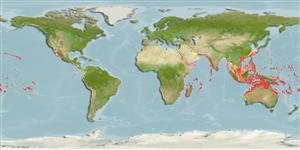
Indo-Pacific: East Africa to Hawaii and the Line, Marquesas and Tuamoto islands, north to the Ryukyu Islands, south to Lord Howe and Rapa islands.
Taille / Poids / Âge
Maturité: Lm ? range ? - ? cm
Max length : 33.0 cm TL mâle / non sexé; (Ref. 9710); common length : 20.0 cm TL mâle / non sexé; (Ref. 30573); poids max. publié: 906.00 g (Ref. 4887)
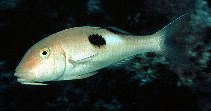
Épines dorsales (Total) : 8; Rayons mous dorsaux (Total) : 9; Épines anales: 1; Rayons mous anaux: 7; Vertèbres: 24. Diagnosis: Pectoral rays 16 (rarely 15 or 17). Gill rakers 6-8 + 21-25 (total 28-32). Body depth 3.45-3.95 in SL; head length (HL) 2.85-3.1 in SL; dorsal profile of snout straight to slightly convex, the snout length 1.7-2.05 in HL; barbel length 1.3-1.55 in HL; longest dorsal spine 1.4-1.7 in HL; last dorsal soft ray of adults longer than penultimate ray, the latter contained 1.1-1.25 in length of the former; posterior margin of caudal-fin lobes straight to slightly convex; pectoral-fin length 1.3-1.5 in HL; pelvic-fin length 1.25-1.45 in HL. Body pinkish to yellowish gray, the scale edges narrowly dark, with a black spot about 3-4 scales in width on lateral line below posterior part of first dorsal fin, followed by a large pale pink to white spot; a blue spot often present on each scale above lateral line, always present posteriorly; pale blue spots, one per scale, ventrally on body, but often not visible; short blue lines radiating from eye except ventrally; barbels pale pink to white; basal third of second dorsal fin with a broad black or blackish band or a large black spot, sometimes extending onto adjacent back, the outer part of fin with narrow blue and yellow bands; anal fin with faint pale blue and yellow bands; remaining fins varying from yellowish gray to light red (Ref. 54393).
Body shape (shape guide): fusiform / normal; Cross section: oval.
Primarily an insular species (Ref. 30573). Usually solitary, it occurs in seagrass beds (Ref. 41878) as well as over sand, rubble, or coral and rock bottoms of shallow lagoon and seaward reefs to a depth of at least 46 m (Ref. 30874). Benthopelagic (Ref. 58302). Feeds on benthic animals like crabs, polychaetes and other worms during the day (Ref. 30874), also shrimps, heart urchins, gastropods, pelecypods, foraminiferans, brittle stars, and fishes (Ref. 37816).
Cycle de vie et comportement reproducteur
Maturité | Reproduction | Frai | Œufs | Fécondité | Larves
Randall, J.E., 2004. Revision of the goatfish genus Parupeneus (Perciformes: Mullidae), with descriptions of two new species. Indo-Pac. Fish. (36):64 p. (Ref. 54393)
Statut dans la liste rouge de l'IUCN (Ref. 130435: Version 2025-2 (Global))
Menace pour l'homme
Harmless
Utilisations par l'homme
Pêcheries: intérêt commercial mineur; pêche sportive: oui; Aquarium: Commercial
Outils
Articles particuliers
Télécharger en XML
Sources Internet
Estimations basées sur des modèles
Température préférée (Réf.
123201): 24.3 - 29, mean 27.8 °C (based on 1504 cells).
Indice de diversité phylogénétique (Réf.
82804): PD
50 = 0.5000 [Uniqueness, from 0.5 = low to 2.0 = high].
Bayesian length-weight: a=0.01175 (0.00543 - 0.02542), b=3.09 (2.92 - 3.26), in cm total length, based on LWR estimates for this Genus-body shape (Ref.
93245).
Niveau trophique (Réf.
69278): 3.4 ±0.2 se; based on diet studies.
Résilience (Réf.
120179): Milieu, temps minimum de doublement de population : 1,4 à 4,4 années (Preliminary K or Fecundity.).
Vulnérabilité de la pêche (Ref.
59153): Low vulnerability (23 of 100).
🛈
Nutriments (Ref.
124155): Calcium = 34 [17, 75] mg/100g; Iron = 0.313 [0.159, 0.686] mg/100g; Protein = 17.8 [14.4, 20.8] %; Omega3 = 0.133 [0.075, 0.243] g/100g; Selenium = 60.6 [29.3, 142.2] μg/100g; VitaminA = 192 [39, 808] μg/100g; Zinc = 0.542 [0.328, 1.028] mg/100g (wet weight);