>
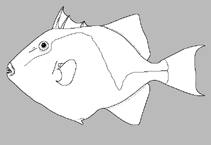
Tetraodontiformes (Puffers and filefishes) >
Balistidae (Triggerfishes)
Etymology: Canthidermis: Greek, kanthos = the outer or inner corner of the eye, where the lids meet, 1646 + Greek, derma = skin (Ref. 45335).
Taxonomic Remarks
Tenrtatively considered as valid. As pointed out by Randall and Mundy, 1998 (Ref. 31346) and Mundy, 2005 (Ref. 58302), a worldwide revision of Canthidermis is necessary to
resolve the taxonomic situation (Ref. 124289:141).
Environnement : milieu / zone climatique / profondeur / gamme de distribution
Écologie
marin pelagic-neritic. Tropical
Indo-West Pacific.
Taille / Poids / Âge
Maturité: Lm ? range ? - ? cm
Max length : 27.2 cm SL mâle / non sexé; (Ref. 44024)
Description synthétique
Clés d'identification | Morphologie | Morphométrie
Rayons mous anaux: 22 - 24.
Body shape (shape guide): short and / or deep.
Cycle de vie et comportement reproducteur
Maturité | Reproduction | Frai | Œufs | Fécondité | Larves
Matsunuma, M., S. Ikeguchi and Y. Kai, 2020. First specimen-based records of Canthidermis macrolepis (Tetraodontiformes: Balistidae) from the Pacific Ocean and comparisons with C. maculata. Species Diversity 25:135-144. (Ref. 124289)
Statut dans la liste rouge de l'IUCN (Ref. 130435: Version 2025-2 (Global))
Menace pour l'homme
Harmless
Utilisations par l'homme
Outils
Articles particuliers
Télécharger en XML
Sources Internet
Estimations basées sur des modèles
Indice de diversité phylogénétique (Réf.
82804): PD
50 = 0.5312 [Uniqueness, from 0.5 = low to 2.0 = high].
Bayesian length-weight: a=0.02754 (0.01326 - 0.05722), b=2.91 (2.74 - 3.08), in cm total length, based on LWR estimates for this (Sub)family-body shape (Ref.
93245).
Niveau trophique (Réf.
69278): 3.4 ±0.5 se; based on size and trophs of closest relatives
Résilience (Réf.
120179): Milieu, temps minimum de doublement de population : 1,4 à 4,4 années (Preliminary K or Fecundity.).
Vulnérabilité de la pêche (Ref.
59153): Low vulnerability (23 of 100).
🛈