>
Gobiiformes (Gobies) >
Eleotridae (Bully sleepers)
Etymology: Mogurnda: Aboriginal name used in Australia.
Environnement : milieu / zone climatique / profondeur / gamme de distribution
Écologie
; eau douce benthopélagique. Subtropical; 13°C - 41°C (Ref. 44894)
Oceania: central Australia.
Taille / Poids / Âge
Maturité: Lm ? range ? - ? cm
Max length : 13.5 cm SL mâle / non sexé; (Ref. 44894)
Description synthétique
Clés d'identification | Morphologie | Morphométrie
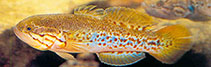
Épines dorsales (Total) : 9 - 10; Rayons mous dorsaux (Total) : 10 - 12; Épines anales: 1; Rayons mous anaux: 10 - 12. Color: three reddish diagonal stripes on head; body with many red spots overlying about 12 faint bluish bars (Ref. 44894).
Body shape (shape guide): fusiform / normal.
Inhabits artesian springs and associated swampy areas over a wide range of temperatures (13°-36°C). At one spring it was found in temperatures ranging from 21.6°-35.6°C, although it was most abundant in the cooler, downstream sections. Feeds on filamentous green algae, snails and fishes. Co-occurs with 5 other species at Dalhousie springs including Neosilurus gloveri (Plotosidae), Craterocephalus dalhousiensis and C. gloveri (Atherinidae), Leiopotherapon unicolor (Terapontidae) and Chlamydogobius gloveri (Gobiidae) (Ref. 44894).
Cycle de vie et comportement reproducteur
Maturité | Reproduction | Frai | Œufs | Fécondité | Larves
Allen, G.R., S.H. Midgley and M. Allen, 2002. Field guide to the freshwater fishes of Australia. Western Australian Museum, Perth, Western Australia. 394 p. (Ref. 44894)
Statut dans la liste rouge de l'IUCN (Ref. 130435: Version 2025-2 (Global))
Menace pour l'homme
Harmless
Utilisations par l'homme
Outils
Articles particuliers
Télécharger en XML
Sources Internet
Estimations basées sur des modèles
Indice de diversité phylogénétique (Réf.
82804): PD
50 = 0.5000 [Uniqueness, from 0.5 = low to 2.0 = high].
Bayesian length-weight: a=0.00977 (0.00411 - 0.02324), b=3.08 (2.88 - 3.28), in cm total length, based on LWR estimates for this (Sub)family-body shape (Ref.
93245).
Niveau trophique (Réf.
69278): 3.4 ±0.5 se; based on size and trophs of closest relatives
Résilience (Réf.
120179): Milieu, temps minimum de doublement de population : 1,4 à 4,4 années (Preliminary K or Fecundity.).
Vulnérabilité de la pêche (Ref.
59153): Low vulnerability (10 of 100).
🛈