Élasmobranches (requins et raies) (sharks and rays) >
Squaliformes (Sleeper and dogfish sharks) >
Etmopteridae (Lantern sharks)
Etymology: Etmopterus: Greek, ethmos, -ou = sieve or ethmoides bone + Greek, pteron = wing, fin (Ref. 45335); caudistigmus: Name refers to the presence of an oval-shaped caudal-fin marking.
More on authors: Last, Burgess & Séret.
Environnement : milieu / zone climatique / profondeur / gamme de distribution
Écologie
marin pelagic-oceanic; profondeur 638 - 793 m (Ref. 45056). Deep-water
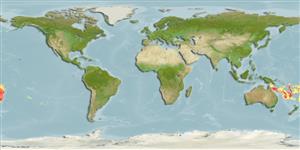
Western Central Pacific: New Caledonia.
Taille / Poids / Âge
Maturité: Lm ? range ? - ? cm
Max length : 31.4 cm TL mâle / non sexé; (Ref. 45056); 33.9 cm TL (female)
Description synthétique
Clés d'identification | Morphologie | Morphométrie
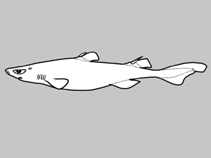
Body moderately firm, slightly compressed body. Dorsal and ventral coloration dark; fins dark distally. Caudal peduncle rather elongate (ca 2.2 times greatest horizontal length of D1 including spine, about 1/5 TL). Mouth relatively broad, 1.4 times eye length. Upper eyelid with pale naked patch. Denticles short, robust, arranged in regular rows. Flank-marking posterior branch truncate and merging ventrally with post-pelvic marking. Anterior part of caudal base marking very broad, enveloping ventral surface and extending to flanks; central caudal oval, well separated from caudal base marking; upper caudal marking straight . Monospondylous centra 40 (Ref. 45056).
Body shape (shape guide): elongated; Cross section: compressed.
Ovoviviparous (Ref. 205).
Cycle de vie et comportement reproducteur
Maturité | Reproduction | Frai | Œufs | Fécondité | Larves
Ovoviviparous, distinct pairing with embrace (Ref. 205).
Last, P., G.H. Burgess and B. Séret, 2002. Description of six new species of lantern-sharks of the genus Etmopterus (Squaloidea: Etmopteridae) from the Australasian region. Cybium 26(3):203-223. (Ref. 45056)
Statut dans la liste rouge de l'IUCN (Ref. 130435: Version 2025-2 (Global))
Menace pour l'homme
Harmless
Utilisations par l'homme
Pêcheries: sans intérêt
Outils
Articles particuliers
Télécharger en XML
Sources Internet
Estimations basées sur des modèles
Température préférée (Réf.
123201): 2.2 - 3.5, mean 2.6 °C (based on 858 cells).
Indice de diversité phylogénétique (Réf.
82804): PD
50 = 0.5000 [Uniqueness, from 0.5 = low to 2.0 = high].
Bayesian length-weight: a=0.00389 (0.00200 - 0.00755), b=3.08 (2.91 - 3.25), in cm total length, based on LWR estimates for this Genus-body shape (Ref.
93245).
Niveau trophique (Réf.
69278): 4.1 ±0.5 se; based on size and trophs of closest relatives
Résilience (Réf.
120179): Faible, temps minimum de doublement de population : 4,5 à 14 années (Fec assumed to be <100).
Vulnérabilité de la pêche (Ref.
59153): Low vulnerability (24 of 100).
🛈