>
Kurtiformes (Nurseryfishes, cardinalfishes.) >
Apogonidae (Cardinalfishes) > Apogoninae
Etymology: Apogon: Greek, a = without + Greek pogon = chin, beard (Ref. 45335); indicus: From the Latin indicus meaning 'of India' - in reference to the Indian Ocean where the holotype was collected and where it is the only member of the A. erythrinus complex (Ref. 40822).
More on author: Greenfield.
Meio ambiente: milieu / Zona climática / intervalo de profundidade / faixa de distribuição
Ecologia
marinhas demersal; intervalo de profundidade 6 - 8 m (Ref. 40822). Tropical
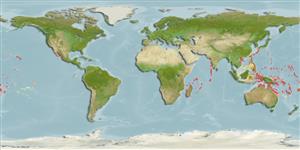
Indo-Pacific: Mauritius to Kiribati.
Tamanho / Peso / Idade
Maturidade: Lm ? range ? - ? cm
Max length : 4.0 cm SL macho/indeterminado; (Ref. 137577)
Descrição suscinta
Chaves de identificação | Morfologia | Morfometria
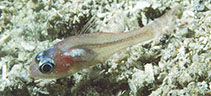
Espinhos dorsais (total) : 7; Raios dorsais (total) : 9; Espinhos anais: 2; Raios anais : 8. Differs from other members of the A. erythrinus complex by having the following characteristics: from A. erythrinus by having a shorter second dorsal fin spine not reaching base of third ray of second dorsal fin when depressed and by usually having 13 pectoral fin rays (versus 14); from A. marquesensis by lacking scattered dark chromatophores on sides of caudal peduncle that extend anteriorly as a band to vertical from caudal fin base to vertical from end of dorsal and anal fin rays (pigment extends forward as a band in A. marquesensis) and by usually having 13 pectoral fin rays (versus 14); from A. susanae by usually having 13 pectoral fin rays (versus 14), by having pigment along the base of the second dorsal fin and on the dorsal surface of the caudal peduncle (pigment lacking in A. susanae), by usually having a well-developed suborbital triangle of pigment (usually lacking or faint in A. susanae, and by having a well-developed pigment blotch on caudal fin base (variable, but often faint or absent in A. susanae (Ref. 40822). Further characterized by having 23 pored lateral line scales; predorsal scales 6; large scales between first dorsal fin and lateral line 2, with smaller third scale at base of dorsal fin; circumpeduncular scales 14; total gill rakers 15, developed gill rakers 7; without free edge of skin near anterior nasal opening (Ref. 93839).
Body shape (shape guide): short and / or deep; Cross section: compressed.
Ciclo de vida ou comportamento de acasalamento
Maturidade | Reprodução | Desova | Ovos | Fecundidade | Larvas
Mouthbrooders (Ref. 240). Distinct pairing during courtship and spawning (Ref. 205).
Greenfield, D.W., 2001. Revision of the Apogon erythrinus complex (Teleostei: Apogonidae). Copeia 2001(2):459-472. (Ref. 40822)
Status na Lista Vermelha da UICN (Ref. 130435: Version 2025-2 (Global))
Ameaça para os humanos
Harmless
Uso pelos humanos
Ferramentas
Relatórios especiais
Baixar XML
Fontes da internet
Estimativas baseadas em modelos
Temperatura preferida (Ref.
123201): 25.4 - 29.3, mean 28.4 °C (based on 1889 cells).
Índice de diversidade filogenética (Ref.
82804): PD
50 = 0.5000 [Uniqueness, from 0.5 = low to 2.0 = high].
Bayesian length-weight: a=0.01514 (0.00700 - 0.03275), b=3.07 (2.89 - 3.25), in cm total length, based on LWR estimates for this (Sub)family-body shape (Ref.
93245).
Nível Trófico (Ref.
69278): 3.3 ±0.4 se; based on size and trophs of closest relatives
Resiliência (Ref.
120179): Elevada, tempo mínimo de duplicação da população menor que 15 meses (Preliminary K or Fecundity.).
Vulnerabilidade da pesca (Ref.
59153): Low vulnerability (10 of 100).
🛈