>
Acanthuriformes (Surgeonfishes) >
Acanthuridae (Surgeonfishes, tangs, unicornfishes) > Acanthurinae
Etymology: Ctenochaetus: Greek, kteis, ktenos = comb + Greek, chaite = hair (Ref. 45335); binotatus: Name from Latin 'bi' meaning two and 'notatus' meaning marked; referring to the black spots at the rear base of the dorsal and anal fins.
More on author: Randall.
Ambiente: milieu / zona climatica / distribuzione batimetrica / gamma di distribuzione
Ecologia
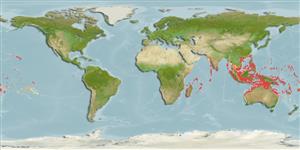
marino associati a barriera corallina; distribuzione batimetrica 0 - 60 m (Ref. 128797), usually 10 - 50 m (Ref. 27115). Tropical; 24°N - 34°S, 29°E - 122°W
Indo-Pacific: East Africa to the Tuamoto Islands, north to southern Japan, south to central New South Wales (Australia) and New Caledonia. Not known from the Red Sea, Gulf of Oman, the Gulf, the Hawaiian Islands, Marquesas, Rapa, Pitcairn Islands, and Easter Island.
Dimensione / Peso / Età
Maturità: Lm ? range ? - ? cm
Max length : 22.0 cm TL maschio/sesso non determinato; (Ref. 5213)
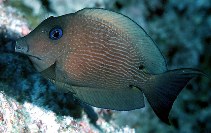
Spine dorsali (totale) : 8; Raggi dorsali molli (totale) : 24 - 27; Spine anali: 3; Raggi anali molli: 22 - 25. Prominent black spot at the rear base of dorsal and anal fins; adults with a bluish ring around the eye (Ref 1602). Dorsal and anal fins dark brown. Caudal fin brown in adults, yellow in young. Edge of lips smooth. Upper teeth usually with 5 denticulations (not including tip). Anterior gill rakers 23-29 (Ref 42056).
Body shape (shape guide): short and / or deep.
Inhabits coral and rubble areas of deep lagoon and seaward reefs. Usually solitary, grazing on surface algae (Ref. 90102). Feeds by scooping film of detritus and unicellular algae (e.g. dinoflagellate Gambierdiscus toxicus) that produce ciguatera toxin making this species a key link in the ciguatera food chain (Ref. 1602, 48637). Caught with nets (Ref. 30573).
Ciclo vitale e comportamento di accoppiamento
Maturità | Riproduzione | Deposizione | Uova | Fecondità | Larve
Randall, J.E and K.D. Clements, 2001. Second revision of the surgeonfish genus Ctenochaetus (Perciformes: Acanthuridae), with descriptions of two new species. Indo-Pac. Fish. (32):33 p. (Ref. 42056)
Stato della Lista Rossa IUCN (Ref. 130435: Version 2025-2 (Global))
Usi umani
Pesca: commerciale; Acquario: Commerciale
Strumenti
Rapporti speciali
Scarica XML
Fonti Internet
Stime basate su modelli
Temperatura preferita (Fonte Biblio.
123201): 24.5 - 28.9, mean 27.7 °C (based on 1034 cells).
Indice di diversità filogenetica (Fonte Biblio.
82804): PD
50 = 0.5020 [Uniqueness, from 0.5 = low to 2.0 = high].
Bayesian length-weight: a=0.03311 (0.02117 - 0.05179), b=2.93 (2.80 - 3.06), in cm total length, based on LWR estimates for this species & (Sub)family-body (Ref.
93245).
Livello trofico (Fonte Biblio.
69278): 2.0 ±0.00 se; based on food items.
Resilienza (Fonte Biblio.
120179): Alto, tempo minimo di raddoppiamento della popolazione meno di 15 mesi (Preliminary K or Fecundity.).
Vulnerabilità della pesca (Ref.
59153): Low vulnerability (12 of 100).
🛈
Nutrienti (Ref.
124155): Calcium = 34.7 [21.3, 57.7] mg/100g; Iron = 0.248 [0.133, 0.599] mg/100g; Protein = 18.1 [16.8, 19.3] %; Omega3 = 0.13 [0.08, 0.21] g/100g; Selenium = 21.9 [12.8, 39.9] μg/100g; VitaminA = 44.8 [10.4, 180.9] μg/100g; Zinc = 0.382 [0.283, 1.300] mg/100g (wet weight); based on
nutrient studies.